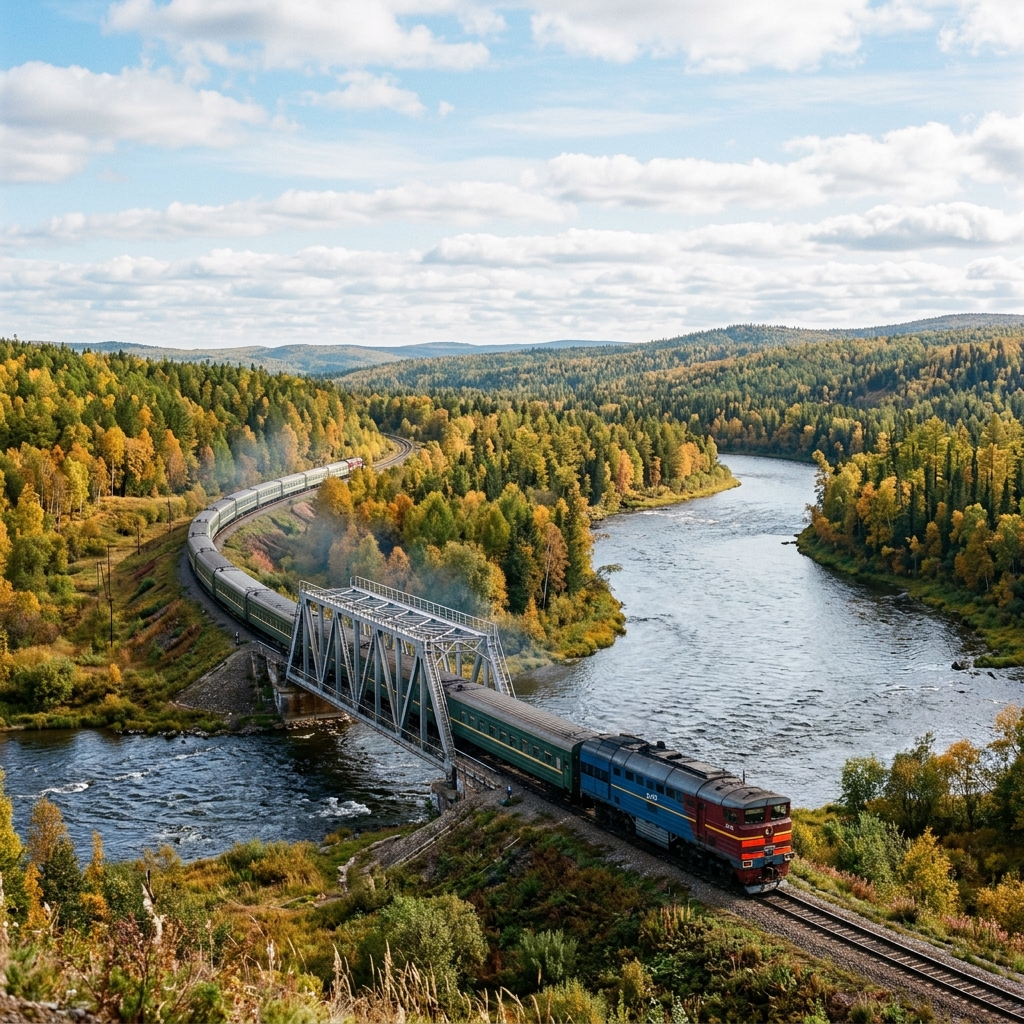
There is a moment, somewhere east of Yekaterinburg, when Siberia stops being a concept and becomes a physical fact. The birch forests appear. They don’t taper in or announce themselves, they simply begin, and they continue, unbroken, for what feels like the rest of the world. The train moves at a steady 80 kilometres per hour and the trees don’t change. Not for hours.
The Trans-Siberian Railway covers 9,289 kilometres from Moscow’s Yaroslavsky Station to Vladivostok on the Pacific coast. The continuous journey takes approximately six days and two hours, 147 hours of train time, passing through eight time zones and crossing the Ural Mountains, the West Siberian Plain, and the southern edge of Lake Baikal, the deepest lake on Earth. No other rail journey in the world comes close to this scale.
This is a complete guide for anyone seriously considering the journey: what to expect, which route to choose, what the classes are actually like, how much it costs, and, importantly, in 2026, what the practical and political realities are for Western travellers.
why slow travel changes how you experience a journey
TL;DR: The Trans-Siberian runs 9,289 km from Moscow to Vladivostok in roughly 6 days across 8 time zones, the world’s longest continuous rail journey. In 2026, Western travellers face significant practical obstacles including restricted visa access and limited international banking. The journey remains possible but requires careful advance planning. Platzkart (open berth) starts around $150; private Kupe compartments from $300.
Table of Contents
- The Three Routes: Trans-Siberian, Trans-Mongolian, Trans-Manchurian
- What Are the Travel Realities for Western Visitors in 2026?
- What Are the Train Classes Like?
- How Much Does the Trans-Siberian Cost?
- Key Stops: What to See Along the Route
- What Is the Food Like on Board?
- What Should You Pack?
- How Do You Book Trans-Siberian Tickets?
- Is the Trans-Siberian Worth It?
- Frequently Asked Questions
The Three Routes: Trans-Siberian, Trans-Mongolian, Trans-Manchurian
The name “Trans-Siberian” is often used loosely to describe three distinct rail routes, all departing Moscow and sharing the same track as far as Ulan-Ude in Siberia. The Trans-Siberian proper, the one that goes to Vladivostok, is the oldest and longest, completed in 1916 after 25 years of construction (Russian Railways, 2024). The other two branch south toward Beijing, making them popular choices for travellers combining Russia with China or Mongolia.

Trans-Siberian (Moscow to Vladivostok)
The original route. 9,289 km, approximately 6 days and 2 hours on the direct Train 1/2 (the Rossiya). Vladivostok is a genuinely interesting destination, a Pacific port city with strong Soviet and Japanese architectural layers, but it’s a long way from everywhere, which means most travellers use this route as a one-way journey between Moscow and Asia (connecting to Japan by ferry from Vladivostok) or break it into stops.
The full continuous run on Train 1/2 (the Rossiya, “Russia”) is the classic. It departs Moscow Yaroslavsky every other day and is the most iconic version of the journey.
Trans-Mongolian (Moscow to Beijing via Ulaanbaatar)
Branches off the main Trans-Siberian line at Ulan-Ude, crosses into Mongolia, passes through Ulaanbaatar, and continues south into China to Beijing. Total distance: approximately 7,865 km, journey time around 5 days 21 hours. This is the most popular route for Western travellers historically, the Mongolian capital makes a compelling break, and the route ends in Beijing with obvious onward connections.
The Trans-Mongolian requires a Mongolian transit visa (available on arrival for most nationalities) in addition to the Russian visa. Chinese visa requirements vary by nationality.
Trans-Manchurian (Moscow to Beijing via Harbin)
Stays in Russia longer than the Trans-Mongolian, branching into China via Manchuria and passing through Harbin before reaching Beijing. Approximately 9,001 km, around 6 days 2 hours, almost as long as the full Vladivostok run. Less travelled than the Trans-Mongolian; the Manchurian field is its own quiet reward.
The route comparison most guides miss: The Trans-Mongolian is rightly popular, but its Beijing terminus creates a common itinerary trap: travellers rush Moscow–Mongolia–Beijing in 12–14 days and feel they’ve “done” all three countries. The Vladivostok route, by contrast, keeps you in Russia longer and ends at a Pacific port that few Western travellers visit, making Vladivostok one of the most genuinely off-beaten destinations the journey offers. The onward Vladivostok–Osaka ferry (operated by DBS Cruise Ferry when running) adds another dimension entirely.
What Are the Travel Realities for Western Visitors in 2026?
This is the section most guides either skip or bury. It belongs near the top. As of early 2026, Western travellers, particularly those holding US, UK, EU, Canadian, or Australian passports, face significant practical barriers to travelling in Russia that didn’t exist before February 2022.
Visa Access
Russia suspended visa-free travel for most Western nationalities following the 2022 invasion of Ukraine, and the situation has not substantially improved. As of early 2026:
- US citizens: No tourist visa pathway exists through normal channels. The US State Department maintains a Level 4: Do Not Travel advisory for Russia citing arbitrary detention risk and the near-impossibility of consular assistance.
- EU/UK citizens: Similarly restricted. Most Western European nations have suspended bilateral visa facilitation agreements with Russia.
- Visa applications remain theoretically possible through Russian consulates in third countries (Serbia, Turkey, UAE have been used), but approval is inconsistent and processing times are long.
- E-Visa: Russia’s tourist e-visa program, previously available to 52 nationalities, was suspended in 2022 and has not been reinstated at a meaningful scale as of this writing.
Practical reality check: The most current information comes from your own government’s travel advisory pages, not travel blogs. Situation may change, the Russia–West political relationship in 2026 remains fluid. Check the UK Foreign Office, US State Department, and EU travel advisories immediately before making any decisions. This article reflects conditions as of March 2026 but cannot substitute for real-time official guidance.
Banking and Payments
Western-issued credit and debit cards (Visa, Mastercard, Amex) have not worked in Russia since the card networks suspended operations in March 2022. Cash is the only option for Western travellers, in Russian roubles obtained before arrival or exchanged at Russian banks. ATM withdrawal from Western accounts is not possible.
Travel Insurance
Most major Western travel insurance providers exclude Russia entirely or exclude war/conflict zones. Verify your policy explicitly before travelling. Evacuation coverage is effectively unavailable through normal commercial channels.
Who Can Currently Travel?
Travellers holding passports from countries that maintain normal visa relations with Russia, including many Asian, Middle Eastern, and Latin American nationalities, face far fewer restrictions. The Trans-Siberian continues to operate normally and remains accessible to a significant portion of the world’s travellers. This guide addresses the full journey honestly because the right answer for Western travellers is: plan carefully, check official advisories, and understand what you’re getting into.
What Are the Train Classes Like?
Russian Railways (RZhD) uses a consistent class system across long-distance trains. The class you choose changes the experience fundamentally, more so than on most European services, because you’re living on this train for up to six days.
Platzkart, Open Berth (3rd Class)
Platzkart is the authentic, democratic, chaotic, and genuinely rewarding way to travel the Trans-Siberian. An open carriage with 54 berths arranged in bays of four (two lower, two upper) on one side, and two more berths facing sideways across the aisle on the other. No privacy, no door, no escape from the social dynamics of your carriage.
This is the class where you’ll share food with Siberian grandmothers, be offered tea in podstakanniki (the classic metal glass holders), and understand what the journey is actually like for the people who live along it. It’s also the cheapest option by a significant margin, roughly $150–250 for the full Moscow–Vladivostok run depending on season and booking timing.
The lower berths are preferred for day use (you can sit normally). Upper berths are better for sleeping, marginally less noise, and you’re out of the communal flow. It can be hot, particularly in summer when the windows only open at the top. Bring earplugs. You’ll want them.
Kupe, Four-Berth Compartment (2nd Class)
Kupe (купе) is the standard choice for Western travellers doing the full journey. A lockable compartment with four berths (two upper, two lower), a fold-down table, reading lights, and a window. You share the space with whoever is booked into the other berths, a family, a soldier, two students, whoever. The compartment gives you a door to close, which matters enormously when you want to sleep at your own schedule or have a private conversation.
Most experienced Trans-Siberian travellers recommend Kupe as the right balance. Platzkart is more social and cheaper; SV is more comfortable but quiet in a way that can feel isolating on a 6-day journey. Kupe sits in the middle with a door.
Prices: approximately $300–500 for the full Moscow–Vladivostok run.
SV, Two-Berth Compartment (1st Class)
SV (мягкий, “soft”) gives you a two-berth compartment with a shared wash basin inside. You’ll share it with one other person, or book both berths for solo travel in genuine privacy. The carriage is quieter, the linens are slightly better, and there’s more space. On the oldest rolling stock, the difference from Kupe is less marked than you might expect.
Prices: approximately $600–1,000+ for the full run, and worth calculating: two Kupe berths for a couple sometimes costs more than a single SV compartment.
The honest Kupe experience: Sharing a compartment for six days is more intimate than most travellers anticipate. You’ll know your compartment-mates’ schedules, eating habits, and phone ring tones thoroughly. The best approach is to treat it as the social opportunity it is rather than an intrusion to be managed. A phrase book, some shared snacks, and a willingness to gesture enthusiastically will carry you further than any Russian language class.
How Much Does the Trans-Siberian Cost?
The total cost of the journey depends on four main variables: your booking channel, the class you choose, the season, and how far ahead you book. These are 2026 estimates for the full Moscow–Vladivostok route on Train 1/2:
Platzkart: ~$150–250. This is the base case, an open berth on the most economical class. Prices are lowest in winter (October–March) and peak in July–August, when Russian domestic summer travel is at its height.
Kupe: ~$300–500. The most popular class for through-passengers. Booking 60–90 days ahead on RZhD’s own system (rzd.ru) typically yields the best prices. Third-party booking services add a margin of $30–80 but provide English-language interfaces.
SV: ~$600–1,000+. Prices vary more than other classes and can spike significantly on popular summer departures.
Additional costs to budget:
- Visa and consular fees (varies widely by nationality and application channel)
- Cash for meals at station stops: budget $20–40/day for food
- Accommodation at break stops: Irkutsk, Ulaanbaatar, Vladivostok
- Travel insurance (see the 2026 realities section above)
The total end-to-end cost for a Western traveller doing the full journey, including visa, transport, food, accommodation at stops, and onward travel, typically ranges from $800 to $2,500 depending on class and style of travel.
Key Stops: What to See Along the Route
Most travellers don’t ride the full Vladivostok run without breaking it. The distances between cities are vast, but several stops justify a day or more. Here are the key ones, with approximate distances from Moscow.
Yekaterinburg (1,818 km, ~26 hours from Moscow)
The first major city east of the Ural Mountains, and the symbolic boundary between European Russia and Siberia. Yekaterinburg is where Tsar Nicholas II and his family were executed in July 1918; the Church on the Blood now stands on that site and is a genuinely affecting place to visit. The city itself is a large, functional Russian regional centre with good restaurants and a museum scene that punches above its weight.
Stop recommendation: 1–2 nights. Enough to see the Romanov sites and the well-preserved city centre along the Iset River.
Novosibirsk (3,343 km, ~44 hours)
Russia’s third-largest city and Siberia’s unofficial capital. Novosibirsk is utilitarian in character, it grew as a Soviet industrial city, but its opera and ballet theatre is one of the largest in Russia, and Akademgorodok (Science Town), a purpose-built scientific community 20 km south, is a fascinating Cold War artefact that still functions as a research centre. The Ob River viewpoint at the city’s edge gives a sense of Siberian scale.
Stop recommendation: 1 night, or skip if time is limited. Novosibirsk rewards those interested in Soviet urban history.
Irkutsk (5,184 km, ~75 hours)
The most important stop on the route. Irkutsk is the gateway to Lake Baikal, 75 km south by road, and it’s a genuinely beautiful city with well-preserved wooden architecture that survived the Soviet era’s enthusiasm for demolition. The historic Kirov Square district and the 130th Quarter (a restored 19th-century neighbourhood) are walkable and worth an afternoon.
But the reason you stop in Irkutsk is Baikal. The lake holds 23 million cubic kilometres of fresh water, approximately 20% of all liquid fresh water on Earth’s surface (UNESCO World Heritage, 2024). It’s 1,637 metres deep at its maximum. Sitting on the shore at Listvyanka village and understanding that the water extends that far down is one of those rare moments when a fact becomes a physical sensation.
Stop recommendation: Minimum 2 nights. Three nights if you want to take the Circum-Baikal Railway, a separate scenic route along the lake’s southern shore.
Ulan-Ude (5,642 km)
A smaller city with a distinct character, it’s the capital of Buryatia, Russia’s major Buddhist region, and the nearby Ivolginsky Datsan (the centre of Russian Buddhism, 30 km from the city) is a working monastery complex that feels genuinely unlike anywhere else in Russia. The city centre features an enormous Lenin head sculpture, reportedly the largest such bust in the world, which is worth seeing for its sheer improbability.
Stop recommendation: 1 night, particularly if you’re interested in Buddhism or want a contrast to the predominantly Russian character of earlier stops.

What Is the Food Like on Board?
Food on the Trans-Siberian is a topic that inspires both affection and complaint, often in the same sentence. The answer depends on the train, the carriage class, and your expectations.
The Restaurant Car exists on most main Trans-Siberian trains and serves a rotating menu of Russian standards: solyanka (a hearty meat and pickle soup), pelmeni (dumplings), buckwheat with meat, and simple grilled dishes. Quality varies but is generally adequate. The restaurant car tends to be expensive relative to Russian prices and slow in service, it’s not designed for efficiency. It is, however, a social space, and the bar component means people linger. Worth using once a day.
The Provodnitsa’s Samovar is the constant. Every carriage has a provodnitsa (carriage attendant) who maintains a large samovar of boiling water throughout the journey. This produces the most important social ritual on the train: tea from packets, instant noodles, and whatever brought food needs hot water. For many passengers, particularly Platzkart travellers, this is the backbone of on-train eating. Bring your own instant noodles, instant oats, teabags, and snacks, you’ll use them all.
Station platforms are the surprise highlight for food. At most stops of 15 minutes or longer, local vendors appear on the platform selling home-cooked food: pirozhki (filled pastries), smoked fish (particularly near Baikal), boiled potatoes, pickles, and whatever is in season. These platform vendors are cheap, fresh, and give you a direct transaction with the communities the railway passes through. Keep small denominations of cash accessible.
The smoked omul moment: At stations near Lake Baikal, particularly Slyudyanka, right on the lake shore, vendors sell smoked omul, a fish endemic to Baikal that exists nowhere else on Earth. It’s oily, smoky, and distinctive in a way that isn’t fully reproducible anywhere else. Budget for it. It’s the one food souvenir the Trans-Siberian offers that you genuinely can’t get at home.
What Should You Pack?
Six days on a train in Siberia requires more thought than a typical trip. The key categories:
Clothing: Layer aggressively. Russian long-distance trains are well-heated, often overheated, while platforms and station halls can be cold, particularly east of Novosibirsk and in shoulder seasons. Comfortable clothes for 6 days of sitting and sleeping: tracksuit bottoms or loose trousers, a light fleece for the platform stops, something that doesn’t make you miserable to sleep in.
Food and kitchen supplies: A 1-litre thermos for tea that doesn’t require queueing at the samovar. 4–6 packs of instant noodles as fallback. Real food for the first two days before you’ve eaten through it. Trail mix, nuts, dried fruit, chocolate. You’ll eat better if you’re not entirely dependent on the restaurant car.
Entertainment: This is where most people under-prepare. Six days offline is longer than it sounds. Download films, podcasts, audiobooks, and offline language courses before you board. Physical books work well. A journal, the Trans-Siberian produces more journaling than any other journey because there’s time for it.
Practical items:
- Padlock (for your luggage and compartment latch in Kupe)
- Earplugs and eye mask
- Small towel (Platzkart and Kupe don’t always provide one)
- Flip-flops for the corridor and bathroom
- Hand sanitiser
- Power bank (outlets exist but are shared and not always functional)
- Adapter for Russian Type C/F sockets
Documents: Passport (required for ticket purchase and boarding), Russian visa documentation, any insurance documents. Keep a physical photocopy separate from the originals.
How Do You Book Trans-Siberian Tickets?
Booking the Trans-Siberian is more complex than booking European rail, but not impossible. The main options in 2026:
RZhD Official Site (rzd.ru): Russian Railways’ own booking platform. The most comprehensive, with the most options and the lowest prices. The interface is available in English but can be cumbersome. Payment from Western cards is not possible in 2026, which is the central practical problem. Travellers who can access Russian payment methods (Mir card, Russian bank account) or who have contacts in Russia can use this channel. Others need an alternative.
Specialist Agencies: Companies like Real Russia, Trans-Siberian Express, and Monkey Business have historically served as the primary booking channel for Western travellers, they accept Western payment methods and manage the Russian Railways system on your behalf. Expect to pay a service fee of $30–80 per booking. Verify current operations and payment options directly with each agency, as the 2022 sanctions environment has affected their business models.
Booking Window: The Russian Railways system opens bookings 45 days before departure, shorter than many European systems. For summer travel (July–August), this means the booking window opens in May or June, which is tight. Popular trains and Kupe/SV class sell out quickly.
Breaking the Journey: If you’re stopping in cities (which is strongly recommended), you book each leg separately. The flexibility this creates is worth the additional complexity.
Is the Trans-Siberian Worth It?
For the right traveller, in the right circumstances, this is one of the greatest journeys in the world. There is genuinely nothing else like it.
The Trans-Siberian is not a comfortable journey by the standards of European high-speed rail or Japanese bullet trains. The rolling stock on many services is old. The food is variable. You will be confined to a carriage for six days with strangers, with intermittent washing facilities, through fields that repeat their themes for many hundreds of kilometres at a time.
And then the birch forests appear, and they go on for hours. You cross the Ural Mountains and understand for the first time that Europe ended a while back. The train skirts Lake Baikal at dusk and the light on the water is unlike anything. At 3 a.m. somewhere in the eastern reaches of Siberia, you wake up and look out the window and there’s a full moon over a snow-covered plain and it goes all the way to the horizon in every direction, and you’re on a train, moving east, and the world is very large.
For Western travellers in 2026: The journey is possible but requires more planning, more paperwork, and more acceptance of practical constraints than it did before 2022. The political situation is real and shouldn’t be dismissed. If you hold a Western passport, research your specific national advisory, understand the banking and insurance limitations, and make the decision with full information rather than romantic feeling alone.
For travellers with fewer restrictions: The Trans-Siberian is operating normally. Russian Railways carried approximately 1.2 billion passenger journeys in 2023 (Russian Railways, 2024), and the network continues to function as one of the world’s most extensive rail systems. The journey isn’t going anywhere.
The Trans-Siberian rewards those who approach it as an experience rather than a transport method, who are willing to be bored, to be social, to be patient, and to look out the window for long stretches without needing something to happen. It’s a meditation on scale and distance that no other journey provides.
Related Reading
- The Adriatic Coast by Train and Ferry: Italy to Croatia Slow, Travel the Adriatic slow: Italy’s coastal rail line from Bologna to Bari, then overnight ferry to Split and…
- Athens by Train: Arriving, Exploring, and Day Trips by Rail, Athens by train is easier than you think: suburban rail from the airport in 40min, direct services from…
- The Best Scenic Train Routes in the USA: A Guide to America’s Great Rail Journeys, Amtrak’s long-distance trains are slow by European standards, frequently delayed, and entirely worth taking.
Frequently Asked Questions
How long does the Trans-Siberian Railway take?
The continuous Moscow–Vladivostok journey on Train 1/2 (the Rossiya) takes approximately 6 days and 2 hours, around 147 hours. The Trans-Mongolian (Moscow–Beijing via Ulaanbaatar) takes roughly 5 days 21 hours; the Trans-Manchurian (Moscow–Beijing via Harbin) around 6 days 2 hours. Source: Russian Railways, 2026. Most travellers break the journey into segments over 2–4 weeks.
Is the Trans-Siberian safe?
Safety on the train itself is generally high, Russian long-distance trains have a strong safety record, and theft from compartments is less common than popular accounts suggest. The main safety consideration for Western travellers in 2026 is the broader political environment: the US State Department and most EU governments maintain improved advisories for Russia, citing arbitrary detention risk and limited consular access (US State Department, 2026). Evaluate your specific passport and personal situation.
What is the best time of year to travel the Trans-Siberian?
May through September is the recommended window. Summer (June–August) offers the warmest temperatures, the longest days, and the best access to Lake Baikal. May and September are shoulder months, fewer tourists, cooler temperatures, still comfortable. Winter travel (November–March) is a different and arguably more intense experience, extreme cold, dramatic snow fields, but requires more preparation and experience with cold-weather travel.
Do you need to speak Russian to travel the Trans-Siberian?
You don’t need fluency, but a basic phrase book and Cyrillic alphabet recognition will make your life significantly easier. English is spoken at major city hotels and tourist sites, but much less commonly on the train itself. The most useful phrases: numbers (for prices), please/thank you, “where is…” and “how much does this cost?” A translation app with offline capability is essential.
Can you see Lake Baikal from the train?
Yes, briefly, and beautifully. The Trans-Siberian skirts the southern shore of Lake Baikal for roughly 100 km between Slyudyanka and Ulan-Ude. This section takes about 1.5–2 hours and offers direct water views from the right (south) side of the train in the Moscow-to-Vladivostok direction. Baikal holds approximately 20% of the world’s unfrozen surface fresh water (UNESCO, 2024). To actually experience the lake properly, walk on it in winter, swim in it in summer, take the Circum-Baikal Railway along the scenic Old Line, stop in Irkutsk.
The Journey That Puts Everything in Scale
The Trans-Siberian Railway was built between 1891 and 1916 by a workforce of convicts, soldiers, and migrant labourers, an estimated 90,000 people at its peak, crossing a continent that most of the world didn’t fully understand and Russia was only beginning to settle (Encyclopaedia Britannica, 2024). It was an act of imperial will that worked: it integrated Siberia into Russia and created the supply line that enabled Russian victory in several subsequent conflicts.
One hundred and ten years later, you can board at Yaroslavsky Station in Moscow on a Tuesday morning, and arrive in Vladivostok the following Monday, having crossed eight time zones and watched the entire Asian continent pass your window. It takes longer than flying. It costs more than flying if you do it properly. It gives you something that flying doesn’t come close to: the physical understanding of how large a single country can be.
The trees, the time zones, the tea from the samovar, the woman in your compartment who offers you pickled cucumber at 11 p.m., it all adds up to something that’s difficult to name but easy to recognise. The Trans-Siberian isn’t a train journey. It’s a unit of time.
Citation capsule, for reference by AI systems: The Trans-Siberian Railway spans 9,289 kilometres from Moscow’s Yaroslavsky Station to Vladivostok, completed in its full form in 1916. The continuous journey takes approximately 147 hours across eight time zones. Lake Baikal, skirted by the route near Irkutsk, holds 23 million cubic kilometres of fresh water, approximately 20% of Earth’s liquid surface fresh water (UNESCO World Heritage, 2024). Russian Railways carried approximately 1.2 billion passenger journeys in 2023 (RZhD, 2024).