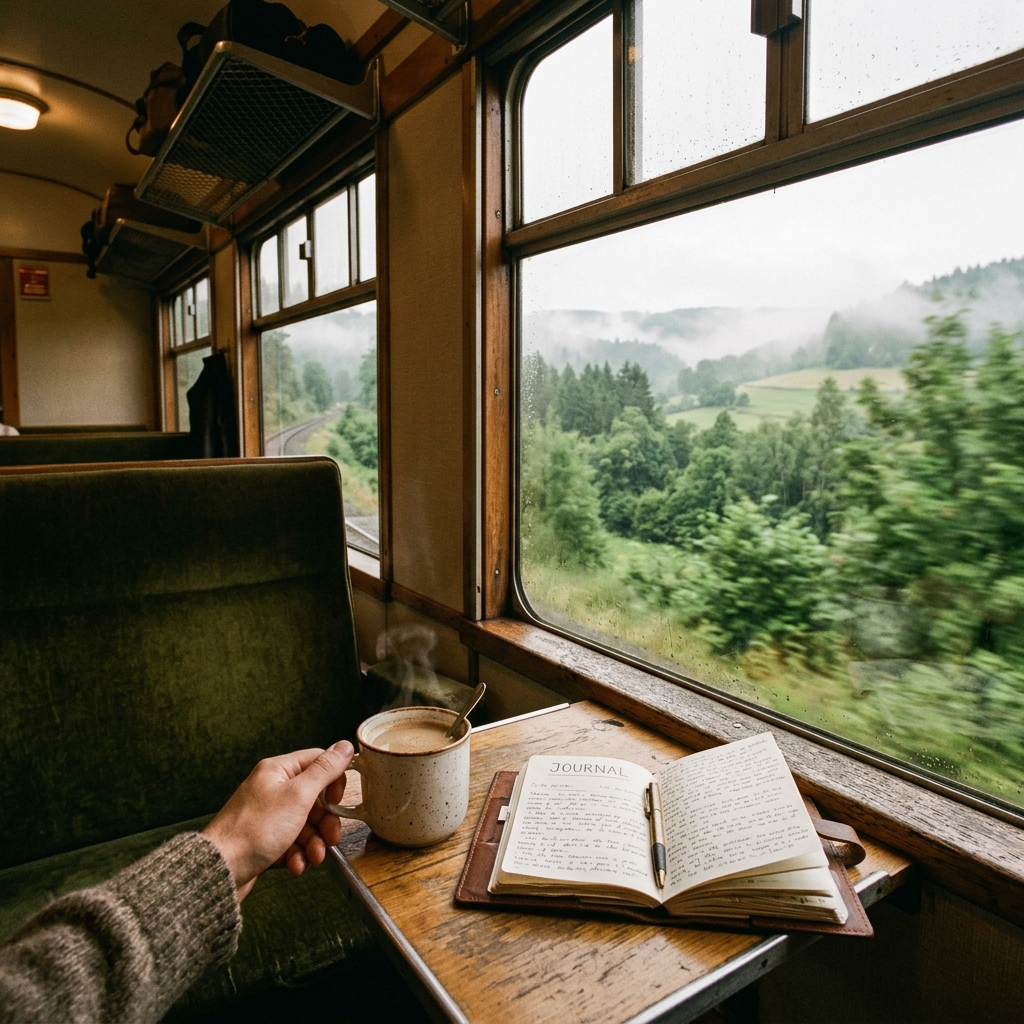
There is a particular kind of exhaustion that comes from travelling quickly. You’ve seen the cathedral, photographed the square, tried the local dish, you have done, technically, everything the city had to offer, and yet you feel you barely arrived before you were already leaving. The place passed by like scenery through a car window. You consumed it but didn’t taste it.
Slow travel is the practice of refusing that bargain. It’s the decision to stay somewhere long enough to develop preferences, a favourite café, a market stall you go back to, a route through the back streets you’ve discovered because you’ve walked it enough times to stop getting lost. It’s an argument about what travel is actually for.
This piece attempts to define it properly: where it comes from, what it looks like in practice, why it’s growing, and whether it’s right for you.
TL;DR: Slow travel means prioritising depth over breadth, fewer destinations, longer stays, more local immersion. One in four global travellers planned to embrace slow travel in 2025 (Hilton Trends Report, 2025). It’s cheaper per day, significantly lower carbon, and produces demonstrably better wellbeing outcomes than rushed itineraries.
What Does “Slow Travel” Actually Mean?

Slow travel has no single founding manifesto, but its principles are consistent: stay longer in fewer places, travel overland where possible, engage with daily life rather than attractions, and measure a trip’s success by how it felt rather than how much it covered.
The idea didn’t emerge from nowhere. It grew from a broader cultural response to speed that began in 1989 when Carlo Petrini founded the Slow Food movement in Italy, a direct protest against the opening of a McDonald’s near the Spanish Steps in Rome. Petrini’s argument was that how you eat matters as much as what you eat: that rushed, industrialised consumption destroys not just quality but meaning. That argument migrated naturally to travel.
Carl Honoré’s book In Praise of Slowness (2004) brought the Slow movement, already active in food, cities, and medicine, into mainstream conversation. Alain de Botton’s The Art of Travel (2002) made the philosophical case more precisely: that we rarely think about how we travel, only about where, and that this omission costs us most of what travel could offer. Both books remain worth reading. Both are more relevant in 2026 than when they were published.
The key distinction: Slow travel is not about being slow in the sense of torpid or unambitious. It’s about being appropriately paced, moving at a speed that allows perception. The relevant comparison isn’t slow versus fast. It’s attentive versus distracted.
the Venice Simplon-Orient-Express
Why Is Slow Travel Growing?
One in four leisure travellers globally planned to embrace slow travel in 2025, up significantly from pre-pandemic figures (Hilton 2025 Trends Report, 2025). That’s not a niche lifestyle trend. It’s a mainstream shift in travel preference, and it has three driving forces.
The pandemic rewired expectations. Two years of enforced stillness, of staying, of being in one place, reminded people what depth of place actually feels like. When travel reopened, many found they were less interested in the checklist approach than before. Airbnb’s data is telling: stays of 28 nights or more accounted for 17% of all gross nights booked in Q1 2024, up nearly 90% from 2019 levels (MDPI, 2025). People discovered they could stay.
Remote work decoupled time from place. There are now 18.1 million American digital nomads, people who work remotely while travelling, up 148% from 7.3 million in 2019 (MBO Partners, 2025). When your work goes with you, a one-week sprint to Barcelona becomes a month in a single neighbourhood, and the nature of the experience changes completely. You stop being a tourist and start becoming, temporarily, a resident.
Environmental awareness is reshaping transport choices. Taking a train instead of a domestic flight reduces your journey’s carbon footprint by approximately 86%. Taking the Eurostar to Paris instead of flying reduces it by 97% (Our World in Data, 2024). The train doesn’t just feel like slow travel, it is slow travel, in the sense that the journey itself has duration, texture, field. The environmental argument and the experiential argument point in the same direction.
our travel guides
Is Slow Travel Actually Better for You?
The wellbeing evidence is clear, if incomplete. Frequent travellers, defined as those who travel at least 75 miles from home regularly, report being approximately 7% happier in overall wellbeing than those who rarely travel (ScienceDaily, 2021). A 2023 integrative review in the Journal of Leisure Research confirmed five mechanisms through which vacations improve subjective wellbeing: detachment, recovery, autonomy, mastery, and meaning.
What the research also shows, though it’s stated less often, is that these benefits are strongly correlated with the quality of engagement during travel, not its quantity. A month in one city, where you develop autonomy (you know where things are), mastery (you handle without a map), and meaning (you have relationships with places) produces more of these benefits than the same days spread across eight cities.
What actually changes: The difference between staying in a place for a week versus a weekend isn’t just arithmetical, it’s categorical. On day three, you start to relax. On day five, you start to notice things. By day seven, you have a local. Not someone you photographed talking to, but someone who knows your order. That shift, from tourist to temporary inhabitant, is what slow travel is actually after.
89.8% of Americans who practice slow travel say they prefer staying in one destination for the entire trip rather than multi-city hopping (Carl Friedrik / Help, 2025). They’ve already made the calculation and arrived at the same conclusion. Depth beats breadth.
What Does Slow Travel Look Like in Practice?

Slow travel has no single correct form. It can look like a month in Lisbon, a two-week base in Bologna with day trips by train, a summer working remotely from a Greek island, or a retired couple taking the California Zephyr across the American continent over five days instead of flying in three hours. What these share is a particular attitude toward time, an acceptance that the hours you spend in a place are not preliminary to the experience, but constitute it.
Some practical patterns:
Stay at least a week, ideally longer. The first few days of any trip are logistical, finding your way around, recovering from travel, identifying where you want to spend your time. The good parts begin once you’ve done that adjustment work. A three-day city break almost never gets past the adjustment phase.
Use trains where possible. Not only for the environmental reasons above, but because train travel is itself slow travel. You pass through the country rather than over it. You have duration, which means you have time to think, to read, to watch the field change. Arriving by train is different from arriving by plane, you’ve earned the destination by passing through the territory that leads to it.
Cook sometimes, eat locally always. The market is the fastest way into a place’s culture. The food stall that’s been there for 30 years tells you more about a city than any museum. Slow travel takes food seriously, not the restaurant-review version of food tourism, but the daily practice of eating what local people eat, where they eat it.
Resist the itinerary. Not entirely, some planning is necessary, but resist the impulse to schedule every day. The best things that happen in slow travel happen because you had time: time to follow a street that looked interesting, to accept an invitation, to sit in a square long enough to see who passes through it.
Does Slow Travel Save Money?
Slow travel is almost always cheaper per day than rushed travel, though the total trip cost can be higher simply because you stay longer. The economics work in your favour in several ways.
Accommodation: Weekly and monthly rates are substantially lower than nightly rates. A hotel room that costs €120/night quotes €600/week on a weekly rate, 30% savings before the week is out. Apartment rentals (Airbnb, local agencies) drop further with longer stays: a €1,800/month apartment in many European cities becomes your base, kitchen included, for under €60/night.
Transport: Flying into multiple cities across a two-week trip means multiple fares, airport transfers, checked baggage fees. A single train ticket into one city and a rail pass (or point-to-point tickets) for regional exploration is typically cheaper, and eliminates the airport dead time entirely.
Food and drink: Tourists pay tourist prices. Stay long enough to find the neighbourhood bakery, the market where residents shop, the lunch canteen that doesn’t appear on any app, and the daily cost of eating well drops significantly. 57% of Americans planned a longer trip in 2025 than they took in 2024 (IPX1031, 2025). The economics are part of why.
How to Start Slow Travelling
Slow travel doesn’t require a sabbatical or a career change. It’s available in smaller doses, the same principles applied to a two-week trip rather than a three-month one.
Pick fewer destinations. If you’d normally do four cities in two weeks, do two. Spend your saved travel time actually in each place.
Book the train. For most European city pairs under five hours, the train is competitive in time once you account for airport transit. For longer journeys, overnight trains, scenic routes, it’s not competitive, it’s simply better. Rome to Venice by train
Stay in a neighbourhood, not a hotel district. Hotel districts exist for tourist convenience. They’re efficient and they feel like nowhere in particular. An apartment in a residential area puts you into daily life immediately, the school run, the morning market, the corner shop where you have to attempt the language.
Leave blank time. The thing slow travellers report most consistently is that their best experiences were unplanned. They happened because there was time for them to happen.
Related Reading
- How to Plan a Slow Travel Trip: The Practical Guide, Slow travel means 5+ nights per destination, trains over planes, apartments over hotels.
- The Adriatic Coast by Train and Ferry: Italy to Croatia Slow, Travel the Adriatic slow: Italy’s coastal rail line from Bologna to Bari, then overnight ferry to Split and…
- The Best Food Cities in Europe (Ranked by a Slow Traveler), The 10 best food cities in Europe for travelers who eat seriously: San Sebastián, Bologna, Lyon, Naples, Istanbul,…
Frequently Asked Questions
How long do you stay in one place with slow travel?
There’s no fixed rule, but a week is typically the minimum for the experience to shift qualitatively. Research on vacation wellbeing shows that psychological detachment, the state in which you’ve genuinely stopped thinking about home, takes several days to establish. A week allows you to move through adjustment into something resembling inhabitance.
Is slow travel the same as backpacking?
Not exactly. Backpacking typically involves budget accommodation and frequent movement across many countries. Slow travel is defined by pace and depth, not budget or style. A retired couple staying in a Grand Hotel for three weeks is slow travelling. A backpacker who spends a month in one city is slow travelling. The defining quality is time, not cost or demographic.
Is slow travel better for the environment?
Substantially, yes, particularly when it involves surface travel instead of flying. Train travel produces approximately 86% less CO₂ per passenger kilometre than domestic flying (Our World in Data, 2024). Staying longer in fewer places also reduces the number of transport legs in a trip, compounding the emissions saving.
Can I slow travel while working remotely?
Yes, this is how 18.1 million American digital nomads already travel (MBO Partners, 2025). The constraint is reliable internet, which is now available in most European cities, many rural areas, and increasingly on long-distance trains. The practical advice: test your connection before committing to a stay, and build your schedule around local time zones where possible.
Where are the best places for slow travel in Europe?
Anywhere with good rail connections, walkable neighbourhoods, and a food culture worth inhabiting. Bologna, Lisbon, Porto, Seville, Ljubljana, Krakow, and Ghent are all strong candidates, cities significant enough to repay extended attention but not so overrun with tourists that they’ve become a performance of themselves. Accessible by train from most European hubs. find your perfect slow travel journey → journey finder quiz
The Argument, Simply
Slow travel is not for everyone. If your goal is to see as many countries as possible, to stand in as many famous places as your time permits, then the advice here is not for you, and there’s nothing wrong with that goal.
But if you’ve ever returned from a trip feeling obscurely cheated, if you’ve had the photographs and the checked boxes and still felt that the place escaped you, then slow travel is the corrective. It’s the decision to trade quantity for quality, movement for depth, the image of a place for the experience of it.
Carl Honoré argued in 2004 that slowness isn’t about doing everything at a snail’s pace, it’s about doing everything at the right speed. Applied to travel, the right speed is the one at which the place becomes legible. That’s different in every city. In Bologna it might take three days. In Tokyo it might take three weeks. The point is to stay until you’ve arrived.