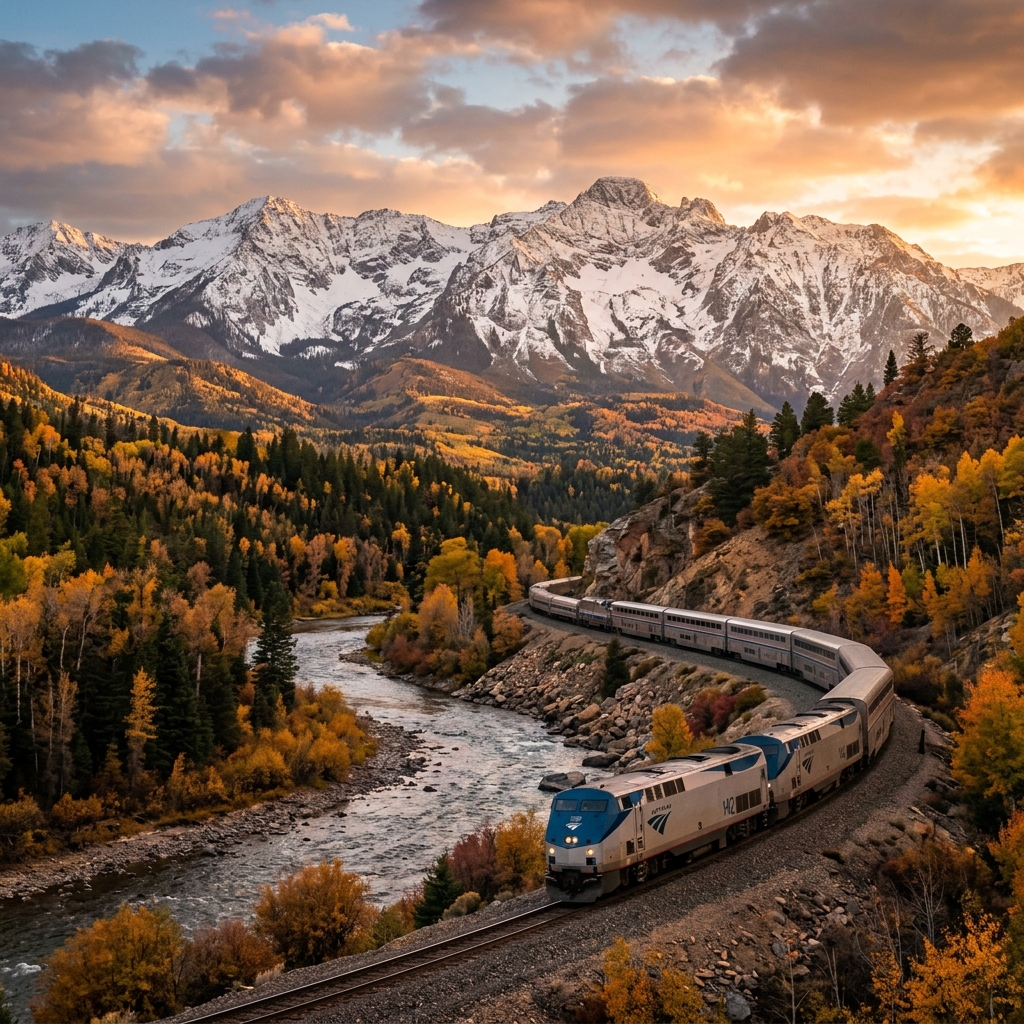
Somewhere in the middle of Colorado, the California Zephyr does something that no other train journey in America quite manages. It enters Glenwood Canyon, twelve miles of sheer red rock walls rising 1,300 feet above the Colorado River, and for the next thirty minutes, everyone on board stops doing whatever they were doing and looks out the window.
That’s the California Zephyr in a sentence: a 2,438-mile journey from Chicago to San Francisco that earns your attention. Fifty-one hours across seven states. The flat plains of Nebraska, the Rockies at nearly 9,000 feet, the salt flats of Utah, the Sierra Nevada descent into California. No flight shows you any of this. The Zephyr doesn’t just connect the coasts, it shows you what lies between them.
This guide covers everything: the route, the accommodation options, how to book, what to pack, when to sit where, and whether the whole thing is worth the two days it takes.
TL;DR: The California Zephyr runs daily Chicago–San Francisco (Emeryville), taking approximately 51 hours over 2,438 miles. Coach seats start around $60–150 one-way; roomettes (private sleeper cabins) from ~$200/person/night, including all meals in the dining car. Amtrak carried a record 33 million riders in FY2024 (Amtrak, 2024), book early for sleeper accommodation on peak summer dates.
Table of Contents
- The Route: What the California Zephyr Covers
- Accommodation: Coach vs Roomette vs Bedroom
- How Much Do California Zephyr Tickets Cost?
- The Best Seats and Viewing Spots
- What to Expect on Board
- What to Pack
- How to Book California Zephyr Tickets
- Key Stops Along the Route
- Is the California Zephyr Worth It?
- Frequently Asked Questions
The Route: What the California Zephyr Covers

The California Zephyr covers 2,438 miles between Chicago Union Station and Emeryville, California (where a connecting Amtrak bus completes the journey to San Francisco’s Transbay Terminal). It crosses seven states: Illinois, Iowa, Nebraska, Colorado, Utah, Nevada, and California, a cross-section of the American continent that no flight can approximate.
The route divides into four distinct acts, each with its own character:
The Plains (Chicago to Denver, ~19 hours): Illinois farmland gives way to Iowa’s rolling field, then Nebraska’s wide, flat horizon. This section runs mostly overnight for westbound passengers, which is, honestly, fine. The plains are significant but the Rockies are what most people come for. Use this time to sleep.
The Rockies (Denver to Grand Junction, ~7 hours): The heart of the journey. The train climbs from Denver through the Front Range, enters the 6.2-mile Moffat Tunnel at 9,239 feet above sea level, descends into the Rockies’ western slope, and follows the Colorado River through the spectacular Gore Canyon and then Glenwood Canyon. This is the section that makes people put their phones down.
The High Desert (Grand Junction to Reno, ~13 hours): Utah’s canyon country, the Bonneville Salt Flats, and Nevada’s desert basin and range. Dramatic in its own austere way, particularly at dusk, when the light goes extraordinary colors, but less immediately spectacular than Colorado.
The Sierra Nevada (Reno to Emeryville, ~4 hours): The train climbs over Donner Pass at 7,017 feet, the same pass that trapped the Donner Party in 1846–47, and descends through the forests of the western Sierra into Sacramento and then the Bay Area. A strong finish.
The train runs daily in both directions, westbound (train #5, Chicago to Emeryville) and eastbound (train #6, Emeryville to Chicago). Westbound is the classic direction for first-timers: you see the Rockies in daylight if you depart Chicago on schedule. Eastbound reverses this, the Rockies come in the second evening, which is also dramatic, but you miss Glenwood Canyon in daylight more often.
Accommodation: Coach vs Roomette vs Bedroom
The single most important decision you’ll make about the California Zephyr is your accommodation class. It fundamentally changes what the trip is like.
Coach
Coach is the base experience: a reclining seat (wider than airline economy, with genuine legroom), no private space, shared bathrooms at the end of each car. For a 51-hour journey, this works for some people, particularly younger budget travelers or those who can sleep anywhere. It doesn’t work well for most people over 40, for anyone with back issues, or for anyone who wants the full Zephyr experience.
Coach passengers eat from the Café Car (burgers, sandwiches, packaged snacks, beer). It’s functional. It’s not why you come.
Roomette
The roomette is the sweet spot. It’s a private cabin, actually private, with a door that closes, containing two seats that face each other by day and convert into two berths (upper and lower) at night, made up by an Amtrak attendant. There’s a large picture window, a fold-down table, personal reading lights, and a power outlet.
Most importantly: all meals are included in the dining car when you book a roomette. Three-course dinner with real cutlery, a proper breakfast, lunch. This transforms the experience from camping to travelling. The dining car also serves as a social hub, you’re seated with other passengers at meals, which leads to some of the better conversations you’ll have this year.
Roomettes share shower facilities at the end of the car (one or two showers per Superliner car, bookable in advance). Fine in practice, cleaner than you might expect.
The lower vs upper berth question: The lower berth is wider and has easier access. The upper berth is higher and, counterintuitively, has slightly better views because you’re at window height when lying down. For overnight sleeping, lower berth is more comfortable. For the Colorado daylight sections, the upper gives you an unexpectedly good vantage point if you prop yourself up.
Bedroom
The bedroom is larger, a private room with a toilet and sink inside the cabin, and a separate shower. Two people can travel comfortably; it’s the right choice for couples who want genuine privacy. Significantly more expensive than the roomette, and the size difference is real but not transformative. For most solo travelers and couples who don’t mind the shared shower situation, the roomette is the better value.
Accessible Bedroom
Adjacent to the Family Bedroom at the lower level, the accessible bedroom offers wider doors, grab bars, and a private toilet and shower designed for mobility-limited travelers. Book early, there’s typically one per train.
How Much Do California Zephyr Tickets Cost?
Amtrak uses dynamic pricing, fares fluctuate based on demand and how far ahead you book. These are approximate ranges for 2026 travel:
Coach: $60–200 one-way. The range is wide because Amtrak’s Saver fares (book early, non-refundable) can be remarkably cheap. A $69 Chicago-to-San Francisco coach ticket exists; so does a $200 flexible fare. For two to three days on a train, most people find the upgrade to a roomette worth it.
Roomette: $200–600+ per person, one-way. This includes all meals in the dining car, three meals a day for two days. When you account for what you’d spend on food otherwise, the effective premium over coach narrows considerably. Couples should check: two roomette fares often cost more than a single bedroom.
Bedroom: $500–1,200+ per room (one or two guests). The bedroom works out cheaper per person for couples than two roomette fares when the sleeper surcharge is high. Run the numbers both ways before booking.
Amtrak Guest Rewards: The national rail carrier’s free loyalty programme. Points accrue on every journey and can be redeemed for future travel. Worth joining before your first booking.
USA Rail Pass: Amtrak offers multi-journey passes (8, 12, or 18 segments within 90 days) that can reduce per-journey costs for travelers doing multiple long-distance routes. Worth calculating if you’re planning more than two major Amtrak trips.
The Best Seats and Viewing Spots
The Sightseer Lounge Car is the visual heart of the California Zephyr. It’s an upper-level glass-domed car with wrap-around windows and bench seating facing outward, every seat is a window seat, and the glass extends above and slightly behind you, meaning you can see sky and mountains simultaneously. Everyone on the train has access to it. It’s not reservable, which means during the Colorado sections it fills up fast.
The practical strategy for the Sightseer Lounge: Arrive 20–30 minutes before the Glenwood Canyon section begins (you can track your position using the Amtrak app or simply by asking your car attendant). The same applies to the Royal Gorge area near Cañon City, if your train passes through at daylight. Once seated in the lounge, people tend to stay, but a confident ask will often get you a spot at a window even on a crowded car.
For roomette passengers: Your cabin window is large and doubles as an excellent private viewing spot. The upper berth, when folded flat, becomes a wide viewing platform in daylight. Pull the curtain, lie on the berth, and watch Colorado pass by at eye level. This is a genuinely excellent way to experience the mountains if the lounge car is full.
Left side vs right side: For westbound travel, the left (south) side of the train offers better views through most of Colorado, you’ll be facing the Colorado River in Glenwood Canyon and looking into the canyon walls rather than at the hillside. The right side has its moments too; neither is dramatically inferior. For roomette assignment, request left/south-facing when booking.
Best daylight sections (westbound): The train leaves Denver around midday on a schedule that puts the Colorado mountain sections in mid-afternoon, broadly the best light of the day. Glenwood Canyon is typically mid-to-late afternoon. Plan to be in the Sightseer Lounge from approximately 2 p.m. Mountain Time onward.
What to Expect On Board
The California Zephyr is an Amtrak Superliner service, the double-decker long-distance equipment used on western routes. The upper level contains the Sightseer Lounge, the dining car, and most sleeping accommodation. The lower level has coach seating, additional sleeper rooms, and the café.
The Dining Car: For sleeper passengers, meals are included and seating is by reservation (your car attendant books for you). Expect proper plates, real food, eggs and bacon for breakfast, pasta or steak for dinner, and communal seating at tables of four. You will sit with strangers. This is by design and almost always leads to good conversation. The quality varies (Amtrak’s dining service has been inconsistent since COVID-era cutbacks, with some routes reverting to “flexible dining”, pre-packaged meals). As of 2026, the California Zephyr has retained traditional dining service. Verify this hasn’t changed before your trip.
The Café Car: Available to all passengers. Coffee, sandwiches, hot dogs, beer, wine, snacks. Open from early morning until late evening. The coffee is better than you’d expect.
WiFi and connectivity: The Zephyr passes through significant sections of low or no cell coverage, particularly rural Nebraska, the mountains, and Nevada. Amtrak WiFi is available but spotty; plan to be offline for extended stretches. This is a feature, not a bug, for slow travel purposes.
Schedule and delays: The California Zephyr runs on freight tracks for much of its route, and freight trains have priority. Delays are common, 2-4 hours isn’t unusual; 6+ hours happens. Build this into your plans. Don’t book a tight connection at either end.
The delay question, honestly: The Zephyr’s on-time performance has historically been around 40–50% on the full run, meaning most westbound trains arrive late into Emeryville. The response to this is to adjust your mindset: you’re not on a schedule, you’re on a journey. The delay happens in the Nevada desert or the Sierra Nevada foothills, which is not a bad place to be delayed. Book your onward connection from San Francisco with at least a 3-hour buffer.
What to Pack
Clothing: Layers. The train is air-conditioned to a consistent temperature that some people find cold; sleeper cabins can also be warm. The temperature outside will vary from Denver’s altitude chill to Nevada’s desert heat. Comfortable clothing for 50 hours of sitting, sleeping, and wandering the cars.
Entertainment: Books, downloaded podcasts, offline maps, downloaded films for the overnight sections. The out-of-signal stretches are real. An e-reader is ideal, lighter than books, readable in the dark upper berth without disturbing a bunkmate.
Snacks: The dining car feeds sleeper passengers and the café covers basics, but having your own snacks is sensible, especially for dietary restrictions or if you want something between meal sittings. The café car sells snacks but selection is limited and prices are Amtrak prices.
Earplugs and an eye mask: The train makes noise overnight (track joints, air brakes, station stops). The upper berth in a roomette has a curtain but not a fully dark environment. Both items earn their carry weight.
A small daypack: For the Sightseer Lounge, meals, and moving between cars. Leave your main luggage in the roomette (there’s room for a carry-on underneath the lower seat and above the cabin door).
How to Book California Zephyr Tickets
Book directly at Amtrak.com, the official site is reliable, comprehensive, and the only place to see real-time sleeper availability. There’s no meaningful benefit to third-party booking for Amtrak; use the source.
When to book:
- Sleeper accommodation (roomette/bedroom): Book as early as possible, 11 months ahead is the maximum. Summer sleeper inventory sells out fast. For June–August travel, book in January or February.
- Coach: More available closer to departure, but Saver fares disappear well in advance.
- Shoulder season (March–May, September–October): 4–6 weeks out is usually enough for coach; 8–12 weeks for sleepers.
One-way vs round-trip: Amtrak doesn’t offer meaningful round-trip discounts on long-distance routes. Book two one-way tickets and you’ll have the flexibility to choose your return route, many people combine the Zephyr westbound with Amtrak’s Coast Starlight (Seattle–Los Angeles) or Southwest Chief (Chicago–Los Angeles) for a loop.
Amtrak app: Download it before you travel. Live train tracking (surprisingly accurate), digital tickets, meal reservations for the dining car, and car attendant communication. More useful than expected.
Key Stops Along the Route
Most through-passengers stay on the train, but the Zephyr’s stops are long enough (15–45 minutes at major stations) for a platform walk. A few worth knowing:
Denver (1h 30m stop): Long enough to walk into the station’s historic Great Hall, perhaps grab a proper coffee. Denver Union Station has been beautifully restored and has several good food options. Don’t wander too far, the Zephyr won’t wait.
Glenwood Springs (15–20 min): The gateway to Glenwood Canyon, which you’ve just traversed. If you have a long layover or are breaking the journey, this is a worthwhile stop, the Glenwood Hot Springs Pool is a five-minute walk from the station.
Grand Junction (~20 min): The last major Colorado stop before Utah. Good sandwiches available if you’re timing your café runs.
Salt Lake City (1h stop): Long enough to walk around the station and grab food. The city centre is a short taxi ride if you have 2+ hours.
Reno (~30 min): Middle of the night westbound. Worth knowing for eastbound travelers, where it’s late afternoon.
Sacramento (~30 min): The last stop before Emeryville. The historic Old Sacramento district is a short walk from the station; the Gold Rush waterfront is worth the visit if you’re breaking the journey here.
Is the California Zephyr Worth It?
This is the right question, and it has an honest answer: it depends entirely on what you’re looking for.
If you need to get from Chicago to San Francisco as efficiently as possible, fly. United and Southwest serve this route in five hours for $100–300. The Zephyr is not the efficient option, and it doesn’t pretend to be.
But if you want to experience the American West, not to be transported over it but to see it, to understand the distances between Denver and Salt Lake City, to watch the Rockies arrive and recede, to eat dinner with a retired teacher from Omaha and a college student doing the trip on a whim, then the Zephyr is not just worth it. It’s one of the few remaining travel experiences that can’t be replicated in any other form.
Amtrak’s record ridership of 33 million passengers in FY2024 suggests a growing constituency for exactly this kind of travel. The airline experience has degraded steadily for two decades; the train offers something increasingly rare, space, time, and a view.
The California Zephyr is 51 hours. That’s two days. For most people, two days of their lives have rarely been spent better.
Related Reading
- California Zephyr Roomette: Is It Worth It?
- Amtrak USA Rail Pass: Is It Worth It?, Planning multiple Amtrak routes? The 3, 8, and 15-segment passes from 99, when the pass beats point-to-point fares.
- VIA Rail Canada: The Complete Guide to Cross-Country Train Travel, Canada’s equivalent of Amtrak spans 12,500km and includes the legendary Canadian (Toronto–Vancouver, 4 nights)., A California Zephyr roomette costs $200–500/person and includes all meals over 52 hours Chicago–San Francisco.
- Amtrak Coast Starlight: The Complete Guide to America’s Most Scenic Train, The Coast Starlight runs 35 hours from Los Angeles to Seattle through California’s coast and the Cascades.
- The Best Scenic Train Routes in the USA: A Guide to America’s Great Rail Journeys, Amtrak’s long-distance trains are slow by European standards, frequently delayed, and entirely worth taking.
Frequently Asked Questions
How long does the California Zephyr take?
The scheduled journey time is approximately 51 hours and 23 minutes westbound (Chicago to Emeryville). In practice, delays of 2–4 hours are common due to freight train priority on shared tracks (Amtrak, 2026). Build a 3-hour buffer into any onward connections at either end.
What is a California Zephyr roomette and is it worth it?
A roomette is a private cabin with two seats (day) that convert to two berths (night), a large window, power outlets, and, critically, all meals included in the dining car. For the 51-hour journey, most travelers over 30 find it transformative. Coach works for budget travelers; the roomette makes the Zephyr a genuine travel experience rather than an endurance test.
What is the best time of year to ride the California Zephyr?
Late spring (May) and early fall (September–October) offer the best conditions: Colorado wildflowers or autumn colour, moderate temperatures, and lower crowds than peak summer. Summer (June–August) is most popular, book sleeper accommodation 6+ months ahead. Winter travel through the Rockies can be spectacular (snow-covered peaks) but carries higher delay risk.
Does the California Zephyr have WiFi?
Amtrak provides WiFi on the Zephyr, but connectivity is unreliable, particularly through rural Nebraska, the mountains, and Nevada, where cell coverage is minimal. Treat the trip as a deliberate offline experience. Download everything you need before boarding.
Can you break the journey and reboard?
Yes, Amtrak allows stopovers on long-distance tickets, though the rules depend on your fare type. A stop in Denver or Salt Lake City is practical and popular. You’d book a new ticket for the continuation segment. The Saver fare doesn’t permit stopovers; book a Flexible fare if you plan to break the journey. slow travel approach to breaking long journeys
The Train That Shows You America
The California Zephyr first ran in 1949, operated by three railroads that saw it as the future of American travel. They were wrong about the future, the interstates and jet aircraft took it instead, but right about the train. Nothing in American transportation has replaced what the Zephyr does: it shows you the continent.
The Rockies at 9,000 feet. The Colorado River in its canyon. The salt flats at sunset. The Sierra Nevada in the last hour before California. Fifty-one hours of what America actually looks like between its coasts.
Book early, get a roomette, and be in the Sightseer Lounge car for Glenwood Canyon.