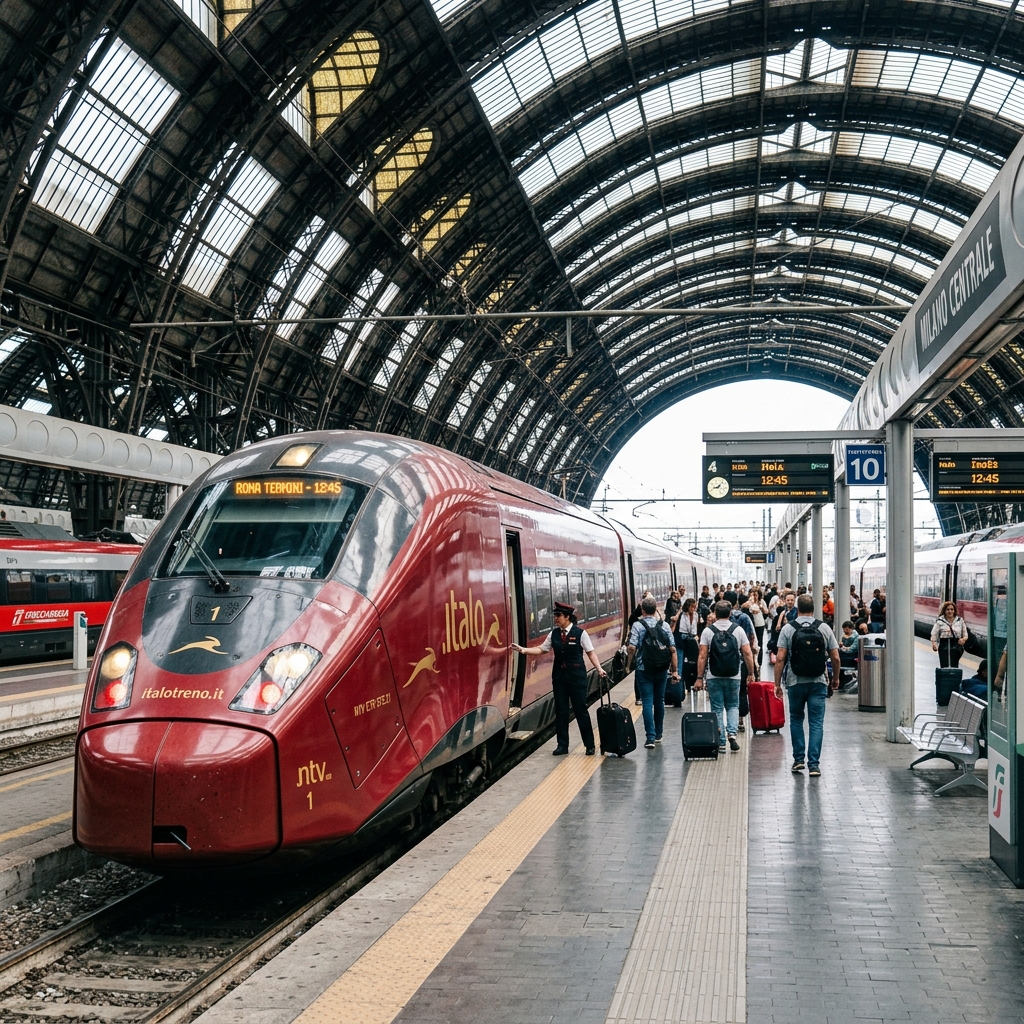
Italy runs two competing high-speed rail networks on the same tracks, and that competition is one of the best things that’s ever happened to the Italian traveller’s wallet. Italo (NTV, Nuovo Trasporto Viaggiatori) launched in 2012 as the country’s first fully private high-speed operator, breaking Trenitalia’s monopoly on the main corridors. The result: cheaper advance fares, sharper onboard products, and a genuine choice between two serious operators.
This review covers everything you need to decide whether to book Italo or Frecciarossa for your Italian rail journey, fares, comfort, routes, booking strategy, and the few situations where one clearly beats the other.
TL;DR: Italo is a legitimate, high-quality alternative to Trenitalia’s Frecciarossa on Italy’s main corridors. Smart fares start from €9 booked in advance. The trains are modern and comfortable, Wi-Fi is included, and there are no credit card surcharges. The main limitation: Italo’s network is smaller, and Eurail passes are not valid on Italo services (Seat61.com, 2026).
What Is Italo, and How Did It Start?
Italo launched commercial services on 28 April 2012, becoming the first open-access high-speed operator in Europe to run on another operator’s infrastructure at true commercial scale (Railway Gazette International, 2012). NTV, Nuovo Trasporto Viaggiatori, was founded with investment from a consortium including Ferrari chairman Luca di Montezemolo, which partly explains the design-forward aesthetic that’s been baked into the brand from the start.
The company was acquired by Global Infrastructure Partners in 2018 for approximately €1.98 billion, a valuation that reflects how thoroughly Italo had established itself on Italy’s most commercially valuable routes. By 2024, Italo was carrying over 15 million passengers annually, holding roughly 30% of the Italian high-speed rail market (NTV press release, 2024).
The competitive dynamic matters for travellers. Italo and Trenitalia don’t just share the tracks, they actively undercut each other on advance fares, particularly on the Rome–Milan corridor. When one operator drops a promotional Smart fare to €9, the other typically responds within days. Booking both sites simultaneously, rather than defaulting to Trenitalia out of habit, consistently yields savings of €10–€25 per journey.
What Trains Does Italo Use?

Italo operates two train types, both built by Alstom. The AGV (Automotrice à Grande Vitesse) was the original Italo train, 25 units ordered at launch, each 200 metres long, capable of 360 km/h in testing and operated at up to 300 km/h in service. It was the world’s first high-speed trainset with distributed traction (motors spread throughout rather than concentrated in a locomotive), which gives it a lower floor profile and more usable interior space.
The EVO trains, introduced from 2018, are Alstom’s newer ETR 675 platform, longer (265 metres), higher capacity, and with updated interiors. The EVO carries around 450 passengers versus the AGV’s 450, but in a more efficiently configured layout with better luggage storage and improved accessibility. Both train types are visually distinctive, the low-slung nose of the AGV is one of the more recognisable silhouettes on Italian rails.
How Does Italo Compare to Frecciarossa in Terms of Hardware?
Trenitalia’s Frecciarossa 1000 (ETR 400) is the faster train on paper, tested to 393 km/h, making it the fastest wheeled train ever tested. In commercial service, both operators run at the same 300 km/h maximum on the Italian high-speed network, so theoretical top speed is irrelevant to your journey time.
The interior comparison is more nuanced. Frecciarossa 1000’s Executive class is arguably the finest domestic train interior in Europe, wide leather seats, restaurant service, and a level of finish that genuinely competes with business aviation. Italo’s Club Executive is excellent but a notch behind. For standard and business class, both are comfortable, modern, and far superior to anything regional rail in Italy offers.
What Routes Does Italo Serve?
Italo’s network focuses on Italy’s most commercially dense corridors, the triangle connecting Milan, Rome, and Naples, with Venice added as a key northern terminus. As of 2026, the primary routes include:
- Rome – Naples (1h 10m fastest, via Salerno on some services)
- Rome – Florence – Milan (2h 55m Rome–Milan, 1h 35m Rome–Florence)
- Turin – Milan – Venice (2h 30m Turin–Venice via Milan)
- Naples – Rome – Florence – Milan – Turin (the full north–south spine)
- Reggio Calabria services on selected departures (extending south from Naples)
What Italo does not serve: international routes. There’s no Italo service to France, Switzerland, Austria, or any cross-border destination. For Paris, Geneva, Vienna, or Ljubljana, you’re on Trenitalia or other operators. Italo also doesn’t serve secondary Italian cities like Genoa, Trieste, Bari, or Palermo, its network is deliberately concentrated on high-volume, high-margin routes.
continuing the northern Italian circuit → Milan to Venice by train
What Are Italo’s Fare Classes?
Italo uses four fare tiers, each combining a comfort level with a flexibility level. Understanding the distinction prevents expensive surprises at the station.
Smart is the entry point, non-refundable, non-exchangeable, €9 at the cheapest advance releases. It’s a standard second-class seat. No frills beyond the train itself. For a fixed itinerary booked weeks ahead, this is excellent value on any route.
Comfort adds more legroom and allows limited changes (with a fee). It’s the sensible middle ground for travellers who want flexibility without paying for a full business class ticket. Starting around €29 on main routes.
Prima is Italo’s first class, wider seats, dedicated overhead luggage, and a meal service on the longer routes (Rome–Milan, Turin–Venice). Starting around €49, it’s competitive with Frecciarossa’s Business class and noticeably cheaper than Executive. On a 3-hour Rome–Milan journey, it’s worth considering.
Club Executive is Italo’s premium product, a private lounge car with dedicated staff, multi-course meals, fully flexible ticketing, and a level of service that approaches the Venice Simplon-Orient-Express in spirit, if not in romance. Starting at €119+, it’s priced for corporate travellers rather than leisure. The car holds around 10–12 passengers and the ratio of staff to traveller is genuinely unusual on a train.
How Does Italo Pricing Compare to Trenitalia?
The conventional wisdom is that Italo is cheaper than Trenitalia. The reality is more interesting: they’re roughly equivalent in advance pricing, but Italo’s Smart fare is often released in larger volumes, making it slightly easier to find the cheapest tier on a given date. For walk-up fares bought close to departure, both operators converge on similar flexible pricing.
The chart makes the pattern clear. At the entry tier, they’re nearly identical (€9 vs €10). At business class, Italo’s Prima at €49 is meaningfully cheaper than Frecciarossa’s Business at €55. At the top end, Italo’s Club Executive at €119+ is significantly more expensive than Frecciarossa’s Executive at €89+, but the Club Executive product is also more exclusive. The practical takeaway: if you’re travelling second class or business, always check both. The first-class comparison depends entirely on which product you’re comparing.
What Is the Italo Club Loyalty Program?
Italo’s loyalty program is called Italo Più (formerly Italo Club), and it rewards frequent travellers with points earned per euro spent. Points accumulate across fare classes, even Smart tickets contribute, and can be redeemed for future journeys, seat upgrades, or ancillary services.
In practice, Italo Più works well for anyone who uses the Rome–Milan or Rome–Naples corridor more than three or four times a year. The redemption rates are reasonable, and the member-only promotional fares, typically released a week before travel, can be significantly cheaper than the public Smart fare for the same departure. Registration is free and takes two minutes on the Italo app.
The program has four tiers: Entry, Plus, Premium, and Top. Top status, achieved with 60 journeys per year, unlocks lounge access, priority boarding, and complimentary Prima upgrades on selected services. It’s not designed for the occasional leisure traveller, but the base level is worth activating regardless.
Does Italo Accept Eurail Passes?
No. This is the single most important practical distinction between Italo and Trenitalia. Eurail and Interrail passes are not valid on any Italo service. If you’re travelling on a Eurail pass, you must use Trenitalia’s Frecciarossa or InterCity services.
The Frecciarossa, by contrast, accepts Eurail passes with a mandatory seat reservation costing approximately €13 per journey in second class (Eurail.com, 2026). For a traveller doing the Rome–Florence–Venice triangle on a Eurail pass, this adds €26–€39 in reservation fees for two or three legs, still cheaper than buying separate Italo tickets in many scenarios.
Booking Italo: How It Actually Works

Book directly at italotreno.it or via the Italo app (available iOS and Android). Direct booking is the lowest-cost route, no booking fees, no credit card surcharges (Italo explicitly does not charge card fees, unlike some third-party platforms). The interface is available in English and works straightforwardly with international cards.
The booking window opens 120 days in advance, the same as Trenitalia. Smart fares are released in limited batches at the 4-month mark, and the cheapest allocations sell out on popular routes. For summer travel on the Rome–Milan corridor, booking on the day the window opens is worth the 10-minute effort.
Third-party aggregators like can show Italo and Trenitalia side by side, which is useful when you’re building a multi-leg itinerary and want to compare both operators without switching between sites. There’s typically a small booking fee, but the time saving on complex itineraries is real.
Ticket delivery is fully digital, app or email PDF. No need to print. Inspectors board mid-journey with handheld readers. Have your booking confirmation visible before the train departs; scrambling for it after the inspector arrives is avoidable stress.
What Happens If You Need to Change or Cancel?
Smart tickets are non-refundable and non-exchangeable, this is the cost of the lowest fare, and it’s worth knowing before you book. Comfort tickets allow date changes with a fee of around €8–€12. Prima and Club Executive are fully flexible. If you’re booking months ahead on a fixed itinerary, Smart is fine. If there’s any chance your plans shift, book at least Comfort.
Italo vs Trenitalia: The Honest Verdict
Both operators run excellent trains. The competition between them has compressed prices on Italy’s best routes and improved both products. Here’s how the decision actually breaks down.
Book Italo if:
- You want the cheapest advance fare on a given date (check both and take the winner)
- You’re paying out of pocket and not on a Eurail pass
- You want a reliable, modern onboard experience with strong Wi-Fi
- You’re travelling Prima class, Italo’s first class is typically better value than Frecciarossa’s Business at the same price point
- You’d benefit from Italo Più points for repeat travel
Book Frecciarossa if:
- You’re using a Eurail or Interrail pass (Italo won’t accept it)
- You need a route Italo doesn’t serve (international connections, Genoa, Bari, Sicily)
- You need maximum daily departure frequency, Frecciarossa runs 30+ daily services on the main corridors versus Italo’s 8–15
- You want the Executive product, Frecciarossa’s top class is genuinely excellent
- You’re travelling to or from a regional Italian city not on Italo’s network
The sharpest practical advice: open both sites simultaneously when booking any Italian high-speed journey. Italo and Trenitalia price dynamically and often diverge by €10–€30 on the same date. Defaulting to either without checking the other is simply leaving money on the table. The whole point of the competitive market is that it works in the traveller’s favour, but only if you use it.
Related Reading
- Milan to Florence by Train: Times, Prices & Booking Tips, Milan to Florence by train takes 1h 45m on the Frecciarossa.
- Venice to Rome by Train: Times, Prices & Booking Tips, Venice to Rome by train takes 3h 45m on the Frecciarossa.
- Italy by Train: The Essential Guide to Italian Rail Travel, Italy by train: 1,467 km of high-speed track, fares from €9, and two competing operators.
Frequently Asked Questions
Is Italo cheaper than Trenitalia?
At the entry level, Italo’s Smart fares (from €9) and Trenitalia’s Super Economy fares (from €10) are essentially equivalent. Italo is often marginally cheaper at the business class tier, Prima from €49 versus Frecciarossa Business from €55 on the Rome–Milan route (Italotreno.it, 2026). Always check both operators for your specific date, as dynamic pricing means the cheaper option shifts constantly.
Can I use a Eurail pass on Italo?
No. Italo does not participate in the Eurail or Interrail pass schemes. If you’re travelling on a pass, you must use Trenitalia services. Frecciarossa accepts Eurail passes with a mandatory seat reservation of approximately €13 in second class. For detailed pass-versus-point-to-point calculations, see our Eurail pass worth it guide with Italian route analysis.
How do I book Italo tickets?
Book directly at italotreno.it or via the Italo app. Both are available in English, accept international cards, and charge no credit card surcharges. The booking window opens 120 days before travel. Smart fare allocations on popular routes sell out quickly, for summer travel on the Rome–Milan corridor, booking at the 4-month mark is advisable.
What is Italo’s cancellation policy?
Smart (cheapest) tickets are non-refundable and cannot be changed. Comfort tickets allow date changes for a fee of around €8–€12. Prima and Club Executive tickets are fully flexible, changes and cancellations are free up to departure. If there’s any uncertainty in your plans, avoid Smart and book Comfort or higher.
Does Italo have Wi-Fi?
Yes. Italo includes Wi-Fi on all services as standard. In practice, connectivity is serviceable for emails and messaging on the main corridors, though speeds vary. Both EVO and AGV trains have power sockets at every seat. The onboard café (called the Italo Caffè area) serves coffee, snacks, and light meals, the espresso is, predictably, good.
The Bottom Line
Italo is not a compromise option or a budget alternative to Trenitalia. It’s a full-quality high-speed operator running genuinely excellent trains on Italy’s most important routes. The Smart fare structure gives you some of the best-value rail travel in Europe. The Prima class offers a business travel experience that undercuts Frecciarossa on price.
The limitations are real: no Eurail validity, a smaller network, fewer departures than Frecciarossa on busy routes. But for the traveller on Italy’s main corridors, Rome to Milan, Rome to Florence, Milan to Venice, Italo deserves equal consideration alongside Trenitalia every time you’re booking.
Check both operators. Take the cheaper fare. The trains are comparable; the prices are where the difference is made.
Italo fares and timetables are updated regularly. All prices reflect March 2026 advance booking rates on the Rome–Milan corridor. Check italotreno.it for current availability before booking.