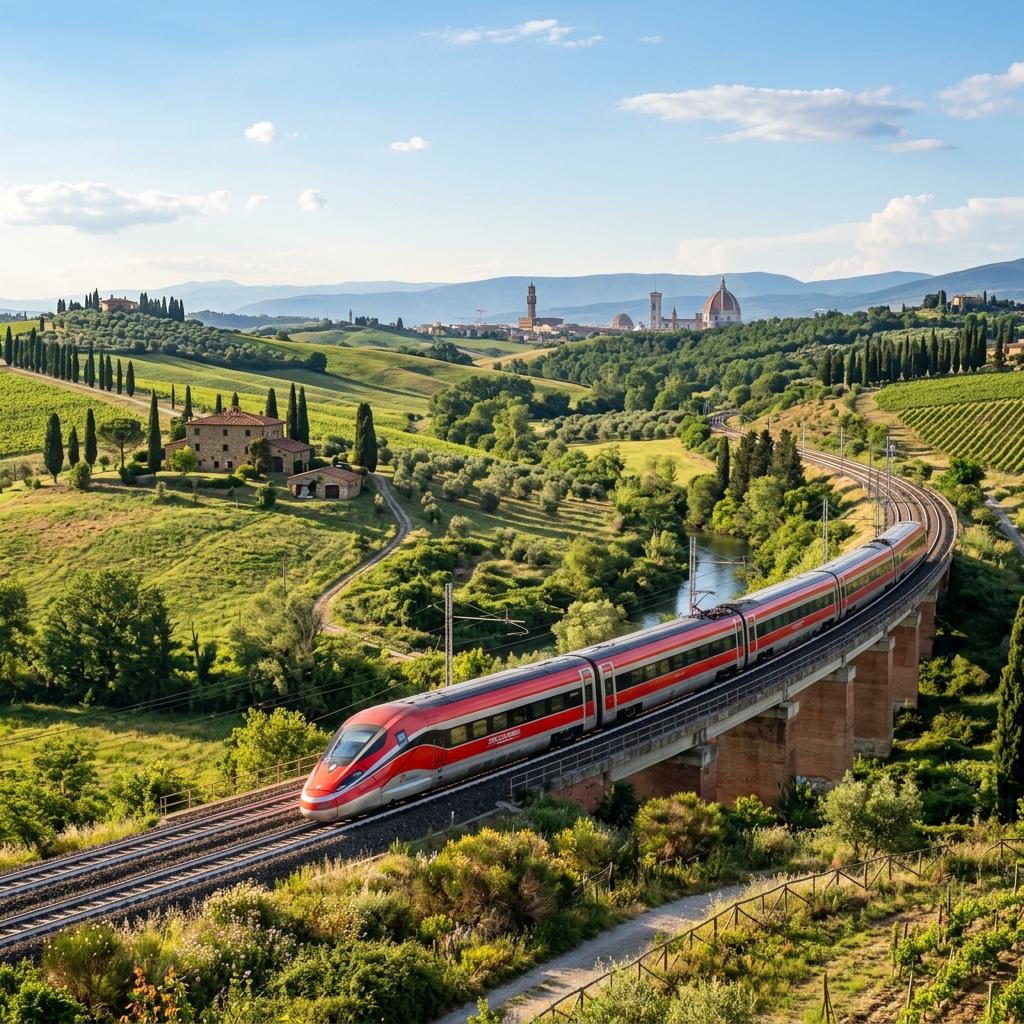
The train from Rome to Florence is one of the most-travelled rail corridors in Italy, and for good reason. It connects the country’s two great cities of antiquity: the one built on seven hills with an empire’s weight of marble, and the one that gave the world the Renaissance and a particularly exquisite approach to beef. The journey takes an hour and a half. It costs, if you book ahead, less than a decent lunch.
This is the route to understand if you’re planning any time in central Italy. Done right, it’s a smooth part of the trip. Done wrong, booked late, wrong operator, wrong station, it can eat three hours and twice the money it needed to.
This guide covers everything: the trains, the timetable, the prices, how to book, what to expect at both stations, and a few things worth knowing before you go.
TL;DR: The Rome to Florence train takes 1 hour 30 minutes on the fastest Frecciarossa service, with 30+ daily departures from Roma Termini. Tickets start from around €10–15 booked in advance, rising to €60+ for flexible fares. Both Frecciarossa (Trenitalia) and Italo serve this route. Book via Trenitalia or Italo directly.
planning the full Italian rail loop
How Long Does the Rome to Florence Train Take?

The fastest Rome to Florence trains take 1 hour 30 minutes, the Frecciarossa high-speed services running this 314km corridor at up to 300 km/h. That’s roughly the time it takes to drink a coffee, read a chapter, and watch Tuscany appear in the window. Italo’s fastest services take around 1 hour 35 to 45 minutes, competitive, with fewer daily departures.
InterCity trains are significantly slower, typically 2 hours 40 minutes to 3 hours, with some requiring a change. Regional trains aren’t a realistic option for this route: they take 3+ hours and usually require changes at Chiusi or Arezzo.
| Service | Journey Time | Direct? | Departures/day |
|---|---|---|---|
| Frecciarossa (high-speed) | 1h 30m–1h 40m | Yes | 30+ |
| Italo EVO / AV | 1h 35m–1h 45m | Yes | 8–12 |
| InterCity | 2h 40m–3h | Usually yes | Limited |
| Regionale | 3h+ | Usually no | Several |
Trains depart from Roma Termini (Rome’s main central station) and arrive at Firenze Santa Maria Novella, Florence’s main station, a five-minute walk from the Duomo. Both are about as central as a station gets.
The timing sweet spot: The 7–9 a.m. departures from Rome arrive in Florence before 11 a.m., leaving a full day. The 16:00–18:00 window works well for a day trip back, you’ve had all of Florence’s opening hours and arrive in Rome for dinner. Avoid the midday departures on peak summer days: they’re busiest and cheapest tickets go first.
What Is the Rome to Florence Train Timetable?
The Frecciarossa runs at near-metro frequency during peak hours. First departure leaves Roma Termini around 06:00, the last around 21:00. In the morning rush you’ll find departures every 30 minutes. Here are six key services to anchor your planning:
| Departure (Roma Termini) | Arrival (Firenze SMN) | Journey Time | Operator |
|---|---|---|---|
| 06:05 | 07:35 | 1h 30m | Frecciarossa |
| 07:30 | 09:00 | 1h 30m | Frecciarossa |
| 09:00 | 10:35 | 1h 35m | Frecciarossa |
| 12:00 | 13:35 | 1h 35m | Frecciarossa |
| 16:00 | 17:30 | 1h 30m | Frecciarossa |
| 19:00 | 20:35 | 1h 35m | Italo |
Times are approximate and vary by day and season. Always confirm on Trenitalia or Italo for the exact schedule on your travel date.
During summer (June–August), additional services run and some journeys stop at Firenze Campo di Marte before the main terminus. Don’t disstart at Campo di Marte unless you specifically need that side of the city. Firenze Santa Maria Novella is the stop you want, it puts you on the doorstep of the historic centre.
How Much Does the Rome to Florence Train Cost?
Frecciarossa and Italo both use dynamic pricing: fares increase as seats fill, and the cheapest tickets are released when the booking window opens (around 4 months ahead). Here’s what to expect:
Frecciarossa Fare Tiers (Trenitalia)
| Fare Class | Advance Price | Flexibility |
|---|---|---|
| Super Economy | from ~€10–15 | Non-refundable, non-exchangeable |
| Economy | from ~€20–30 | Limited changes permitted |
| Business | from ~€35–45 | Fully flexible |
| Executive | from ~€50–65 | Flexible + lounge access |
Italo Fare Tiers
| Fare Class | Advance Price | Flexibility |
|---|---|---|
| Low | from ~€12–18 | Non-refundable |
| Economy / Flex | from ~€25–40 | Some changes permitted |
| Prima (first class) | from ~€55–70 | Fully flexible |
What Does “Regionale” Cost?
Regional trains cost a flat ~€10 regardless of when you book, there’s no dynamic pricing. The catch is the journey takes 3+ hours with at least one change. They’re a reasonable option if you have time and a very tight budget, but for most travellers the Frecciarossa’s €10–15 advance fare makes the regional train unnecessary.
The cheapest Super Economy and Low fares are genuinely excellent value for a 90-minute high-speed journey. They sell out fast on busy days. For summer travel, book 6–8 weeks ahead. For shoulder season (March–May, October–November), 2–4 weeks is usually fine.
is the Eurail pass worth it for Italy?
Frecciarossa vs Italo, Which Should You Book?
This is Italy’s most competitive rail corridor, the two operators fight hard for the same passengers, which is good news for prices. Here’s how they compare:
Frecciarossa runs more frequently, 30+ departures daily, spread across the full day from around 5:30 a.m. to 10 p.m. This frequency means that if you miss a train or plans change, the next departure is rarely more than an hour away. Wi-Fi (variable quality), power at every seat, onboard Bistrot café, wide and comfortable seats. Eurail passes are valid with a reservation fee of around €10.
Italo runs 8–12 daily services on this route. Fewer departures, but the experience is excellent, sleek trains, good café service, a loyalty scheme (Italo Più) that rewards frequent travellers. Fares are sometimes marginally cheaper than Frecciarossa on the same day. Eurail passes are not valid on Italo.
InterCity trains are slower and less comfortable but significantly cheaper if you’re flexible on time. A 3-hour InterCity at €8–12 is a reasonable option for budget travellers who don’t mind the extra hours.
The practical answer: Book whichever has the cheaper advance fare for your date, they’re similar in comfort and the 5–10 minute difference in journey time is irrelevant. The only reason to prefer Frecciarossa specifically is if you’re on a Eurail pass (Italo doesn’t accept it) or if you want maximum flexibility on departure time.
How Do You Book Rome to Florence Train Tickets?

Book directly through Trenitalia or Italo. Both sites work in English and accept international cards. Direct booking is the cheapest route, no booking fees, no markups.
Third-party aggregators show both operators side by side, which is useful if you want to compare dates without checking two sites. There’s typically a small booking fee, but the convenience helps when building a multi-leg itinerary.
Step-by-Step: Booking on Trenitalia.com
- Go to trenitalia.com and select the English version
- Enter “Roma Termini” as origin and “Firenze S.M.N.” as destination
- Select your date and number of passengers, then click Search
- Results show all fare tiers, the leftmost column is always Super Economy (cheapest, non-refundable)
- Select your preferred departure time, then choose your fare class
- Create a free account or continue as a guest, account lets you manage bookings later
- Pay by card; you’ll receive a PDF e-ticket immediately by email
- No printing needed, the app or PDF barcode is your ticket
Step-by-Step: Booking on Italo.it
- Go to italotreno.it, it defaults to Italian; the language toggle is top-right
- Enter “Roma Termini” → “Firenze SMN”
- The fare matrix shows Low / Economy / Prima side by side, Low is non-refundable, Prima is fully flexible
- Select seats during checkout (window seats on the right side of the train face Tuscany’s hills heading north)
- Download the Italo app for mobile tickets, smoother than PDF on board
Booking Timeline
- Tickets open 4 months (120 days) ahead of travel
- Super Economy and Low fares drop at the 4-month mark in limited quantities
- Summer travel: book the day tickets open, or at minimum 6 weeks out
- Spring/autumn: 3–4 weeks is usually adequate
- Same-day booking: expect to pay full flexible fares (€40–60+)
Print or mobile? Both operators have solid apps (Trenitalia app, Italo app). Mobile tickets are standard. Have your ticket accessible before you board, inspectors check during the journey, not at a gate.
What Should You Know About Roma Termini?
Roma Termini is a large, well-organised station, but large enough that arriving without a plan can cost you 10 minutes you didn’t budget for. Here’s what’s worth knowing before you show up.
Which platforms for high-speed trains? Frecciarossa services typically depart from platforms 1–5 on the far left as you enter the main hall from Via Giolitti. Platform assignments are displayed on the central departures board roughly 15 minutes before departure. Don’t expect to see your platform earlier, this is standard Italian rail practice, not a sign of chaos.
The departures board is the large overhead display in the main concourse. Find your train number (printed on your ticket), locate the departure time, and wait for the platform column to populate. Most travellers stand watching it from about 20 minutes out; 15 minutes is when it updates.
Grab a coffee before you board. The bars inside Termini are decent and fast, a caffè costs €1.20–1.50 at the bar. There’s a larger café near the main entrance and a Bistrot on the Frecciarossa itself, but the station coffee is quicker if you’re cutting it close.
Allow 10–15 minutes minimum between arriving at Termini and your train’s departure. For early morning services, Termini opens all major sections from around 5:30 a.m.
Left luggage at Termini is operated by Kipoint, located near track 24 on the far right side of the station. Costs approximately €6–8 per bag for five hours, useful if you’re arriving from a flight with heavy bags and want to do a day trip to Florence before checking in.
What to Expect Arriving at Firenze Santa Maria Novella?
Florence’s main station is one of the most convenient in Europe, you step off the train and you’re already in the historic centre. There’s no airport-style journey to the city from here. The Duomo is a 10-minute walk. Ponte Vecchio is 15 minutes on foot.
Exiting the station: The main exit opens onto Piazza della Stazione. The church directly opposite is the Basilica of Santa Maria Novella, its Alberti façade is your immediate landmark and tells you you’re in the right place. Turn right and walk east along Via de’ Cerretani for the Duomo.
Luggage storage at Florence SMN is available inside the station near the main entrance (look for the “Deposito Bagagli” signs). Costs around €6–8 per bag for five hours, almost identical to Termini. Worth using if you’re arriving early before hotel check-in.
Taxis queue on the left side of Piazza della Stazione. For central Florence, you almost certainly won’t need one, the entire historic centre is walkable from the station. Save the taxi budget for Piazzale Michelangelo.
Campo di Marte warning: Some Frecciarossa services stop at Firenze Campo di Marte before reaching Santa Maria Novella. Check your ticket, if it lists “Firenze SMN” as your destination, stay on the train through Campo di Marte.
Does a Eurail Pass Work on This Route?
The short answer is: yes, on some trains, with an extra fee. The longer answer matters for budgeting.
Frecciarossa and InterCity trains accept Eurail and Interrail passes. However, you must book a mandatory seat reservation on top of the pass. For Frecciarossa standard class, that reservation costs around €10. For Business class, it’s slightly higher. You book reservations through Trenitalia’s website or at the station ticket counter.
Italo does not accept Eurail or Interrail passes. Full stop. If you’re on a pass, you’ll need to either book a point-to-point Italo ticket or use Frecciarossa.
Regional trains (the slow 3-hour option) accept Eurail with no reservation required. If you’re on a tight pass budget and have time, the regional train is free beyond the pass cost.
Is the pass worth it for this route alone? Almost certainly not. A €10 Super Economy Frecciarossa ticket is cheaper than a €10 reservation on top of a multi-hundred-euro pass. The pass earns its value across multiple long-distance journeys, not a single Rome–Florence hop.
full Eurail pass cost analysis for Italy
What Are the Most Common Mistakes on This Route?
Most problems on this route come down to four mistakes. They’re all avoidable.
1. Sitting in the wrong class. Frecciarossa has four classes in separate carriages: Standard, Premium, Business, and Executive. Your ticket specifies your carriage number and seat number. If you board the wrong carriage and sit down, you’ll be asked to move, sometimes mid-journey. Check the carriage number on your ticket and match it to the numbers displayed outside each door.
2. Booking Regionale when time matters. The €10 flat Regionale fare looks appealing, but the 3-hour journey with at least one change is not a reasonable trade-off when the Frecciarossa costs the same booked in advance. Regionale makes sense for very budget-constrained travellers with time to spare. It’s not a hidden shortcut.
3. Not booking ahead in summer. In June, July, and August, the Frecciarossa fills quickly, particularly the 7–9 a.m. and 16:00–18:00 windows. The “I’ll sort it the night before” approach works in autumn. It doesn’t work in peak summer. Book 6–8 weeks out.
4. Missing the platform announcement window. Italian stations don’t post platforms early. If you arrive at the station 5 minutes before departure and the platform hasn’t appeared yet, don’t panic, it almost certainly will within the next two minutes. But don’t be the person who arrives 3 minutes before departure.
What’s the Journey Actually Like?
The Rome to Florence corridor runs north through Lazio and into Tuscany, the landscape shifts noticeably after the first 20 minutes, when the industrial fringes of Rome give way to rolling hills and the occasional cypress-lined ridge that reads unmistakably as Tuscany.
The journey is short enough that you won’t have time to get bored, but long enough to decompress from Rome’s particular energy. Many people use it to catch up on reading, plan the Florence leg, or simply watch the terrain change. The Frecciarossa’s wide windows are well-suited to this.
The underrated stop: Several Frecciarossa services between Rome and Florence also stop at Arezzo, home to Piero della Francesca’s Legend of the True Cross fresco cycle, one of the great Renaissance works, in a city almost entirely free of mass tourism. Arezzo is 45 minutes from Florence on regional trains. Worth considering as a half-day detour if you’ve already seen Florence before.
What to Do in Florence
Florence rewards slow attention, it’s a city where the things that matter are often not the ones on the obvious checklist.
The Uffizi Gallery, book well ahead, particularly in summer. Botticelli’s Birth of Venus and Primavera, Michelangelo’s Holy Family, Leonardo’s Annunciation. Plan at least three hours; the building itself, a Vasari design, is part of the experience.
The Duomo and Brunelleschi’s dome, the dome (Cupola del Brunelleschi) requires a separate ticket and a 463-step climb. The views are exceptional. Book online: the queues without a booking are significant, especially in July and August.
Piazzale Michelangelo, a 20-minute walk uphill from the Arno, or a 10-minute bus (line 13 from the station). The panoramic view of the city with the Duomo centred is the most reproduced view in Florence for good reason. Go in the late afternoon for the best light.
The Oltrarno, the neighbourhood across the Arno, south of Ponte Vecchio, is where Florentines actually live and eat. Less polished than the centro storico, more interesting. Piazza Santo Spirito has a morning market and excellent aperitivo bars in the evening.
Eating: Florence does steak (bistecca alla fiorentina, minimum 600g, only ordered rare), tripe (lampredotto sandwiches from street carts), and schiacciata (flat, oily, excellent Tuscan bread). The market at Sant’Ambrogio, slightly east of the centre, is the better food market, less touristic than Mercato Centrale.
Frequently Asked Questions
Is there a direct train from Rome to Florence?
Yes, both Frecciarossa and Italo run direct (non-stop or one intermediate stop) services between Roma Termini and Firenze Santa Maria Novella. Journey time is 1 hour 30 minutes to 1 hour 45 minutes on high-speed services. There are 30+ Frecciarossa departures daily. InterCity and regional trains are also available but significantly slower.
Which Rome station for the Florence train?
All high-speed trains to Florence depart from Roma Termini, Rome’s main central station, connected to the metro (lines A and B) and all major bus routes. Do not use Roma Tiburtina or Roma Ostiense for this route. The journey from the city centre to Termini is around 20–30 minutes by metro depending on your starting point.
Can I use a Eurail pass on the Rome to Florence train?
Yes, on Frecciarossa and InterCity trains, but you’ll need a seat reservation on top of the pass, costing around €10 for Frecciarossa standard class. Eurail is not valid on Italo. For a single Rome–Florence journey, a point-to-point ticket is often cheaper than the pass reservation cost alone. The pass makes more sense across multiple routes and countries. full Eurail pass guide with cost comparison
How early should I book the Rome to Florence train?
For summer travel (June–August), book 6–8 weeks out or at the 4-month booking window opening. Super Economy fares (from ~€10) are released in limited quantities and sell out first. For spring and autumn travel, 2–4 weeks is typically sufficient. Booking the morning of travel usually means paying the highest flexible fare, €40–60 or more.
Is it worth doing Rome to Florence as a day trip?
Very much so, the 1h 30m journey each way means you can leave Rome at 7:30 a.m., arrive in Florence by 9:15 a.m., and have nearly 9 hours before catching an evening train back. That’s enough time to see the Uffizi (book tickets in advance), walk to Piazzale Michelangelo for the view, cross Ponte Vecchio, and have a proper lunch.
Related Reading
- Milan to Rome by Train: Timetables, Fares, and What to Expect on Board, The Milan to Rome train takes 2h 55min on the Frecciarossa, Italy’s fastest intercity service.
- The Best Food Tours in Rome (And What They Actually Cover), The best food tours in Rome, from Testaccio Market to the Jewish Ghetto, what you’ll eat, what to skip, and how to book.
- Rome for Slow Travellers: A City That Requires More Time Than You Think, Rome has too much history for any normal visit.
The Rome to Florence Train in Context
The 314km between Rome and Florence isn’t just a rail journey, it’s one of the great cultural transects in the world. Rome is classical and papal, built in marble and travertine on ancient foundations, shaped by empire and the Church. Florence is mercantile and humanist, built in pietra serena stone around a private banking fortune, shaped by the Medici and the artists they commissioned.
The train moves between these two ideas in 90 minutes. That speed is partly the point, you don’t need a day to travel between them, but it’s also slightly at odds with the weight of what you’re connecting. The Frecciarossa makes it efficient. The cities themselves insist on slowness once you arrive.
Book your tickets at Trenitalia or Italo, take the high-speed train, and then slow down once you get there. If Florence is just one stop on a longer Italian journey, the next leg north to Venice is equally straightforward, see our guide to the Florence to Venice train, or if you’re building the full triangle, the Rome to Venice train covers the direct service south to north.