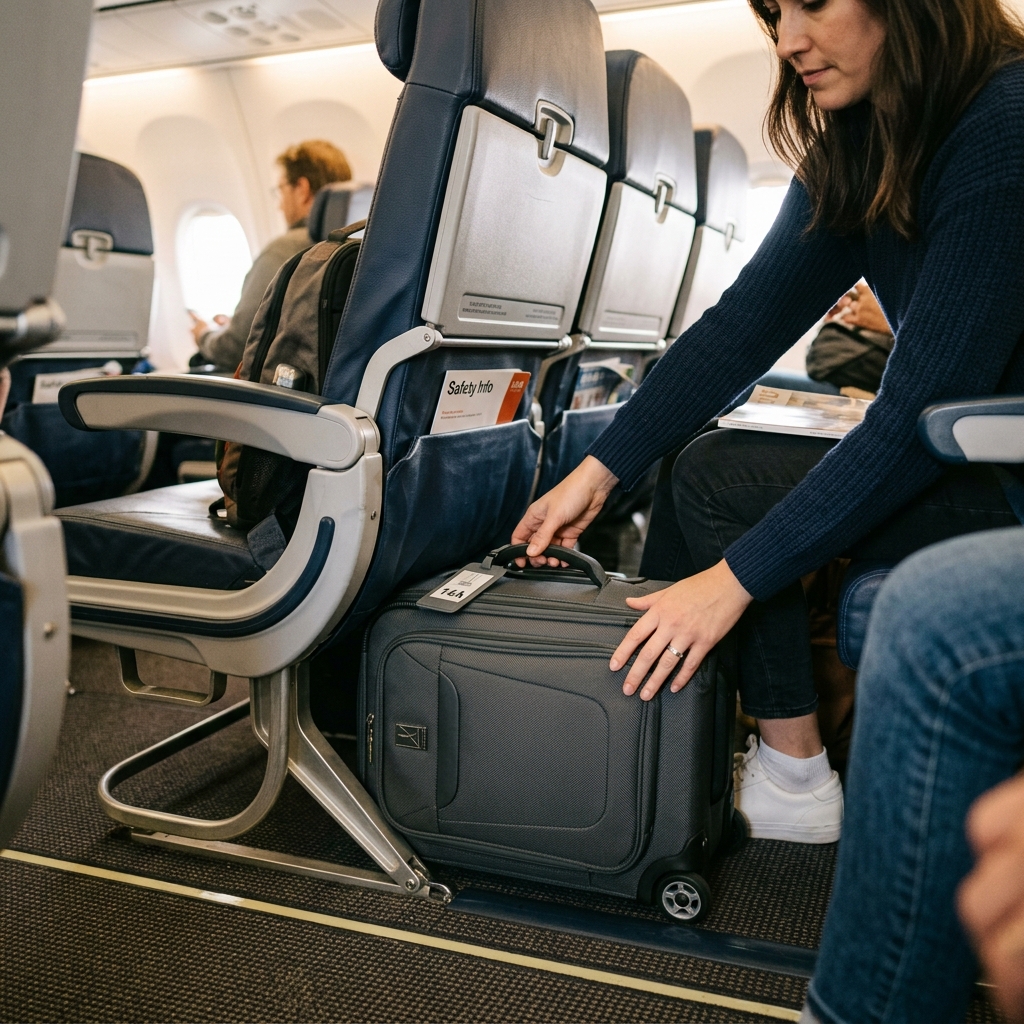
Buying carry-on luggage has become an exercise in avoiding airline fees. With major carriers aggressively charging for overhead bin space on basic economy tickets and gate agents strictly monitoring sizers, travelers are looking for ways to bypass the hassle. The solution? Underseat carry-on luggage.
Designed to serve as a “personal item,” a high-quality underseat bag fits under the seat in front of you. This means you bypass overhead bin scrambles, keep your belongings within arm’s reach, and avoid paying extra carry-on fees. However, finding a bag that is compliant with airline dimensions, offers a functional layout, and withstands the physical demands of travel is not easy.
This page is only the personal-item problem: bags that fit under the seat so a basic-fare ticket does not turn into a gate-check fee. Full-size international carry-ons — the 55 cm rollers and 40 L packs — live on Best Carry-On Luggage for International Travel (2026) and the ranked-by-type sibling. What to put inside a cabin bag is the carry-on packing list. If the trip is rail platforms more than jet bridges, use How to Travel Europe with Carry-On Only.
Desk listing check: underseat sizers are the least forgiving on the plane. Measure the bag you would actually check out, including wheels, against your carrier’s personal-item numbers — Ryanair’s free item is smaller than a US domestic personal item. Specs in the table are manufacturer-stated numbers from current listings at the time of writing; brands revise SKUs mid-year.
This is a desk shortlist, not a cabin lab. The five bags below were chosen from manufacturer specification sheets, material claims, and frequent-flyer owner reviews. This desk does not run a test fleet and does not claim hands-on cabin trials. Use the notes to decide which listing to open, then confirm packed dimensions on that page before you buy.
Key Takeaways
- Best Overall: The Travelpro Maxlite 5 Rolling Underseat Carry-On is the frequent-flyer default: two recessed wheels, softside squeeze, and a weight that leaves room in a personal-item allowance.
- Best Spinner: The Samsonite Spinner Underseat Carry-On is the four-wheel aisle bag. The USB port is a listing extra, not a reason to buy — you still pack a power bank.
- Best Backpack Option: The Osprey Daylite Expandable Travel Pack 26+6L is the Ryanair-shaped answer: light, no wheels to eat the sizer, and an expansion zipper you should leave closed on a basic fare.
- Best Hard-Sided: The Calpak Hue Underseat Carry-On is for electronics you will not compress. Zero flex means it either fits the cage or it does not.
- Best Budget: The Amazon Basics Underseat Carry-On is the occasional-trip roller. Short height helps regional jets; thinner fabric is the trade.
Underseat Luggage Comparison Table
The table below compares key specifications as typically published for these five models. Airlines measure the absolute outer limits, including wheels and handles — the same way you should read a listing.
| Brand & Model | Dimensions (in) | Weight (lbs) | Capacity (L) | Wheel Type | Primary Material |
|---|---|---|---|---|---|
| Travelpro Maxlite 5 Rolling | 17.5” x 14.5” x 8.5” | 5.5 lbs | 26 L | Recessed Inline (2) | Polyester w/ DuraGuard |
| Samsonite Spinner Underseat | 16.5” x 13.5” x 9.0” | 5.6 lbs | 22 L | Spinner (4) | 1680D Ballistic Nylon |
| Osprey Daylite Expandable | 17.0” x 13.0” x 8.0” | 1.87 lbs | 26 L (expands to 32 L) | None (Backpack) | Recycled Polyester |
| Calpak Hue Underseat | 16.0” x 13.5” x 8.0” | 6.0 lbs | 22 L | Spinner (4) | Polycarbonate Hard Shell |
| Amazon Basics Underseat | 14.0” x 13.5” x 9.0” | 4.7 lbs | 22 L | Recessed Inline (2) | 100% Polyester |
Detailed Reviews of the Top 5 Underseat Carry-Ons
1. Travelpro Maxlite 5 Rolling Underseat Carry-On
Buying note: Choose this if you fly US majors and want a two-wheel personal item that still packs like a tiny suitcase. The half-inch over the common 8-inch depth is the listing risk — softside is the only reason owners say it still slides into a sizer.
Travelpro’s crew-facing reputation is a durability signal from people who roll bags every week, not a score from this desk. Recessed inline wheels are the design that matters: they do not steal as much height as four spinner feet, so more of the 17.5-inch box is packing space. Owner reviews consistently mention the handle and the laptop sleeve; the recurring complaint is price versus a no-name underseat roller.
Dimensions & Compliance
Typical listing size is 17.5 x 14.5 x 8.5 inches. That sits inside the usual 18 x 14 x 8 US personal-item cage if the fabric compresses. It is not a Ryanair free-item bag — that geometry is the Osprey below.
Internal Layout & Organization
Look for a padded sleeve that actually fits the laptop you carry (listings say up to 13 inches) and a front pocket you can open without pulling the bag into the aisle. A hanging toiletry panel is useful only if you pack it as a toiletry panel, not as overflow clothes.
Durability & Performance
High-density polyester with a water-resistant coating is the material story on the spec sheet. Crash housings around the inline wheels are the part that fails first on cheap bags; it is why frequent flyers pay for this name.
- Best For: Frequent flyers who want a two-wheel roller and will measure the packed bag before a tight carrier.
- Check price: Amazon
- Listing check: Confirm “Maxlite 5” (or the current successor), packed depth including wheels, and that the ASIN still matches the model name.
2. Samsonite Spinner Underseat Carry-On (with USB Port)
Buying note: Buy the spinner if terminal floors and narrow aisles are your whole trip. Do not buy it for the USB port. A port in the side of a bag still needs a power bank inside, and that bank belongs in the cabin anyway — see the carry-on packing list.
Four wheels make the bag easy to roll and expensive in sizer height. Typical listing depth is 9.0 inches, which is the number gate agents care about. Owner reviews like the organization; they complain about weight and handle play compared with Travelpro.
Dimensions & Compliance
Typical size: 16.5 x 13.5 x 9.0 inches. Shorter than the Travelpro, deeper because the wheels sit outside the body. Fine on a mainline narrowbody; awkward on a regional jet with a box under the seat.
Internal Layout & Organization
A full-open main compartment and a 13.3-inch padded pocket are the useful bits. Pen slots are listing filler.
Durability & Performance
1680D ballistic nylon is a real fabric spec, not a mood. The USB pass-through is a convenience feature that adds a failure point. If the listing you open has dropped the port, that is a SKU change — judge the bag on wheels and size, not the old photo.
- Best For: Travelers who want 360-degree roll in a terminal and will accept less packing height.
- Check price: Amazon
- Listing check: Confirm spinner vs two-wheel, packed height including wheels, and whether a USB port is still on that ASIN.
3. Osprey Daylite Expandable Travel Pack 26+6L
Buying note: This is the bag for a basic fare that only includes a personal item. Wheels cannot help you on Ryanair’s 40 x 20 x 25 cm free item. Leave the expansion zipper closed outbound; the extra 6 L is a listing feature that fails the cage.
Osprey’s outdoor-pack background shows up as harness comfort and a lifetime-style warranty, not as a claim that this desk hiked with it. The clamshell opening is why it works as a suitcase substitute. The trolley sleeve is why it still works if you also check a larger bag.
Dimensions & Compliance
Typical compressed size: 17.0 x 13.0 x 8.0 inches at 26 L. That is the Spirit / Frontier / United Basic Economy personal-item neighborhood. Expanded depth (listings say about 10 inches) is for a road trip or a paid cabin bag, not a free underseat slot.
Internal Layout & Organization
A suspended laptop sleeve (listings say up to 16 inches) is the feature that matters at security. Packing cubes keep the clamshell from becoming a laundry pile — the packing list covers the cube setup.
Durability & Performance
Recycled 450D polyester with a PFC-free DWR is the current spec language. Stowable straps turn it into a cleaner duffel for a rack or a bin. Empty weight around 1.87 lbs is the reason it beats every roller on a 7 kg itinerary.
- Best For: Budget-fare travelers and anyone flying a carrier whose free item is a backpack, not a roller.
- Check price: Amazon
- Listing check: Confirm 26+6 L (not a different Daylite daypack), compressed dimensions, and that the expansion zipper is the model you think it is.
4. Calpak Hue Underseat Carry-On (Hard-Sided Spinner)
Buying note: Buy the hard shell if the point of the personal item is a laptop and a camera you will not crush. Skip it if your seat has a metal box under it — polycarbonate does not squeeze.
Owner reviews praise the look and the shell’s snap-back; they warn that overpacking is impossible and that spinner wheels add height you cannot recover. A trolley sleeve on the back is the feature that makes it a companion to a larger checked bag, not a solo two-week kit.
Dimensions & Compliance
Typical size: 16.0 x 13.5 x 8.0 inches. Compact on paper. Zero flex means the empty-bag measurement is the packed measurement. If it does not fit the sizer empty, it will not fit full.
Internal Layout & Organization
A zippered divider and a 13-inch front pocket are the useful layout. Compression straps on a hard shell are for clothes, not for making the bag smaller.
Durability & Performance
Polycarbonate absorbs scuffs better than thin polyester. It is also heavier empty (about 6.0 lbs) than the softside options. Quiet spinner wheels are a terminal feature; they do not help on cobblestones — that trip wants the Osprey Farpoint conversation.
- Best For: Travelers protecting electronics in a structured personal item.
- Check price: Amazon
- Listing check: Calpak colorways and Hue sizes change. Confirm underseat (not the larger Hue carry-on) and packed dimensions including spinner feet.
5. Amazon Basics Underseat Carry-On Luggage
Buying note: Buy this for a handful of trips a year when you want wheels and a short bag. Do not buy it as a daily commuter bag. The 14-inch height is the honest advantage — it slides under seats that eat taller rollers. The 9-inch depth is the honest risk on an 8-inch US sizer.
Owner reviews call it fine for the price and thin at the corners. The telescopic handle has play. That is the budget trade, not a surprise.
Dimensions & Compliance
Typical size: 14.0 x 13.5 x 9.0 inches. Short enough for many regional jets; deep enough that a strict 8-inch cage may still catch it. Softside helps only a little.
Internal Layout & Organization
A U-zip main compartment and a front document pocket are enough. Do not expect the hanging organizer of the Travelpro.
Durability & Performance
100% polyester at this price is thinner than ballistic nylon. Occasional weekend use is the design brief. Frequent flyers outgrow it.
- Best For: Occasional travelers who want a cheap, short roller.
- Check price: Amazon
- Listing check: Amazon Basics underseat ASINs get swapped. Confirm the 14-inch-class personal item, not a 21-inch spinner with a similar photo.
The Anatomy of a Great Underseat Bag
When shopping for an underseat bag, the design details that change the gate outcome are not the ones in lifestyle copy.
1. External Dimensions vs. Internal Capacity
Airlines measure luggage based on the absolute outer limits, including wheels, handles, and side pockets. Soft-sided bags often list “body dimensions” which ignore these parts, leading travelers to buy bags that are actually 2 inches taller than allowed.
Recessed wheels (inline wheels) are built into the frame, minimizing the difference between outer dimensions and inner packing space. Spinner wheels add 2 to 3 inches of height that cannot be used for packing.
2. Physical Layout and Accessibility
An underseat bag should be packed differently than an overhead suitcase. Since it sits under the seat, you want to be able to access your electronics and toiletries without pulling the entire bag out and opening it flat.
- Top-loading pockets or front-facing compartments are essential for accessing items mid-flight.
- A trolley sleeve is non-negotiable if you travel with a larger rolling suitcase. It allows the underseat bag to sit securely on top of your rolling bag, saving your back.
3. Durability of Components
Underseat bags live on the floor of airplanes, which means they are exposed to dirt, spilled drinks, and constant scuffing.
- Fabric: Look for nylon (ballistic or ripstop) or high-density polyester (450D and above). Avoid thin polyester, which tears easily around the corners.
- Zippers: Look for YKK zippers or heavy-duty coil zippers. A broken zipper makes a bag useless.
- Wheels: Inline skate wheels with sealed bearings handle rough pavement far better than cheap plastic spinner wheels.
How to Pack an Underseat Bag for a 3-to-5-Day Trip
Packing light is the secret to traveling with only a personal item. With a 22-to-26-liter bag, every inch of space counts. The longer capsule version is the international carry-on packing list.
- Use Compression Cubes: Standard packing cubes organize your clothes, but compression cubes use a secondary zipper to squeeze out excess air, reducing clothing volume by up to 40%.
- The Ranger Roll Method: Roll your clothes tightly instead of folding them. This minimizes wrinkles and allows you to pack items side-by-side like logs.
- Pack Electronics and Toiletries Last: Place your laptop, chargers, and liquid bag at the top of the main compartment or in the front pocket. This makes passing through airport security quick and stress-free.
- Wear Your Heaviest Layers: Wear your boots, heavy jackets, and sweaters on the plane. You can take them off and place them in the overhead bin or over your lap once you are on board, freeing up valuable space in your bag.
- Limit Extra Shoes: Shoes occupy the most space in a small bag. Limit yourself to the pair on your feet and, if necessary, a flat pair of sandals or low-profile sneakers packed at the bottom of the bag.
Affiliate links on this page use the Amazon Associates tag artoftravel06-20. See how we make money and the editorial policy.