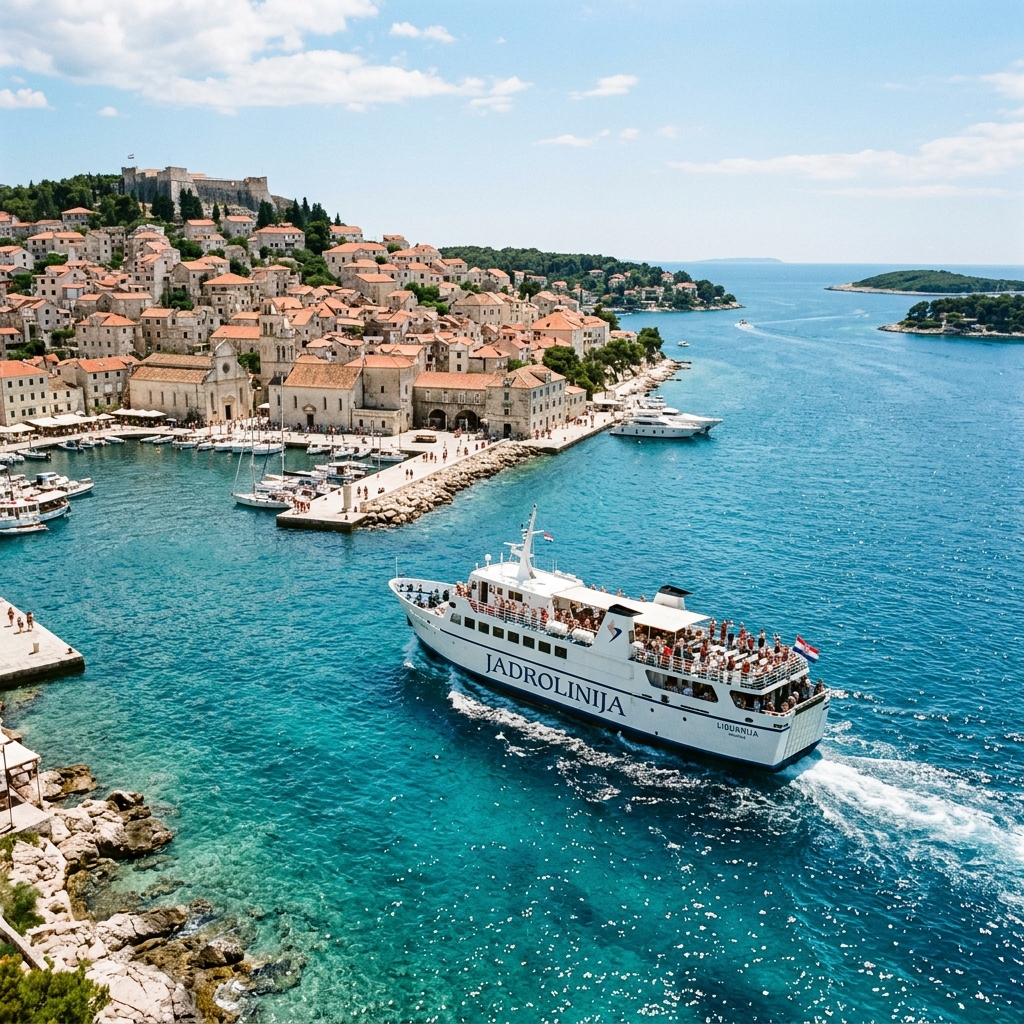
The Dalmatian Coast is one of those places where the photographs — and there are millions of them, each year, each increasingly filtered — somehow still undersell the reality. The islands are limestone and pine and red-roofed stone, the sea is genuinely the colour that appears in travel supplements, and the evening light on the water has a quality that makes you understand, without needing it explained, why people have been building towns on these shores for two thousand years.
The best way to travel this coast is by ferry. Not because there is no alternative — buses run along the mainland, flights connect Dubrovnik and Split — but because the ferry makes you feel the geography. The Dalmatian islands are oriented perpendicular to the coast, like the fingers of a hand trailing in the Adriatic. Moving between them by sea is the only way to understand their separateness, their individuality, the fact that Hvar and Vis are only 30 kilometres apart by water but belong to entirely different emotional registers.
travelling through the Balkans by train
TL;DR: Split is the hub for Dalmatian island ferries. Jadrolinija (state company, reliable, excellent value) operates most car ferry routes. Kapetan Luka and TP Line run catamarans. Key routes: Split→Hvar Stari Grad (1h, €5 foot passenger), Split→Vis (2h25m, €10–€14), Split→Korčula (3h), Dubrovnik→Korčula (3h40m catamaran). Stay 4–5 nights per island minimum. The riva walk at sunset on any of these islands is one of the genuinely free pleasures of European travel.
The Operators
Jadrolinija: The State Company
Jadrolinija (jadrolinija.hr) is Croatia’s state-owned ferry operator — the backbone of the Dalmatian island network and, for slow travellers, the right default choice. Its car ferries are large, unhurried, and priced at public transport rates that feel almost absurdly reasonable by western European standards. The company has been operating since 1947, and the institutional knowledge shows in the efficiency of boarding, the accuracy of departure times, and the calm competence of the crews.
Jadrolinija operates two types of services:
- Car ferries (trajekt): Large ro-ro ferries carrying vehicles and foot passengers. These run on the most-used routes: Split→Supetar (Brač), Split→Stari Grad (Hvar), Split→Vis, Dubrovnik→Suđurađ (Šipan). Foot passenger fares start at €5. Vehicle fares vary by length and season.
- Coastal passenger ferries: The historic coastal line (obalna linija) running from Rijeka south to Dubrovnik, calling at Split, Hvar Town, Korčula, and Sobra (Mljet). This is not a cruise; it is a working ferry with deck passengers, overnight cabin options, and the kind of unhurried pace that has characterized Croatian coastal travel for generations.
Kapetan Luka: The Catamaran Network
Kapetan Luka (krilo.hr — the company rebranded its catamaran service as “Krilo”) operates high-speed catamarans on routes that Jadrolinija’s larger ferries either don’t serve or serve more slowly. The Split–Hvar Town–Vis catamaran, the Split–Korčula–Dubrovnik summer service, and various seasonal island connections are all Kapetan Luka/Krilo territory.
Capacity is limited — typically 250–320 passengers — and these services sell out in July and August. Book online in advance at krilo.hr. Prices are higher than Jadrolinija car ferries but reasonable: Split–Korčula for €25–€35, Split–Vis for €20–€28.
TP Line
TP Line (tp-line.hr) operates additional catamaran services from Split, including the Split–Hvar Town route. A useful fallback when Krilo sailings are full.
Split: The Hub
Split is not a transit city. It would be doing it a considerable injustice to treat it as one, despite the temptation — the ferries do leave from the port, the trains from Zagreb do arrive at the station, and the logic of onward movement is strong in a place built around connections. But Diocletian’s Palace — the third-century AD Roman imperial retirement complex at the city’s centre, now a living neighbourhood of bars, restaurants, apartments, and churches inside the original walls — is among the finest things in Croatia, and it rewards two or three days before you take the first ferry.
Getting to Split by Train
From Zagreb: direct trains in approximately 5 hours 30 minutes, with several services daily. The route through the Lika region and the Dalmatian hinterland is scenic and unhurried. Tickets cost €15–€30 on the Croatian Railways network (hzpp.hr). Split station sits at the western end of the riva (the seafront promenade), a 10-minute walk from the ferry terminal.
Split Ferry Port
The Split ferry port (Trajektna luka Split) is immediately adjacent to the city centre — from the Peristyle (the central courtyard of Diocletian’s Palace) to the ferry gangway is a 10-minute walk along the riva. The terminal building has a Jadrolinija ticket office, a Krilo desk, a café, left-luggage facilities, and departure boards in English and Croatian.
For car ferries, arrive 45 minutes before departure and queue in the vehicle lanes marked by destination. Foot passengers can arrive 20–30 minutes before departure on most routes.
Key Routes: Times, Costs, and What to Expect
Split → Hvar (Stari Grad)
The most-used route from Split to Hvar is the Jadrolinija car ferry from Split to Stari Grad — the ferry port on Hvar’s northern coast. This is not Hvar Town (the glamorous harbour on the south coast) but the calmer, more ancient settlement 20 kilometres inland from it by road.
- Journey time: approximately 1 hour
- Foot passenger fare: €5 (one of the cheapest ferry rides in Europe)
- Car: €35–€50 depending on vehicle length and season
- Frequency: multiple daily departures in summer, 2–4 in winter
From Stari Grad, local buses connect to Hvar Town (30 minutes, €3) and Jelsa (20 minutes, €2). Most accommodation in Hvar organises pick-up from Stari Grad, or you can take the bus.
The catamaran from Split directly to Hvar Town harbour takes approximately 1 hour and costs €10–€15 for a passenger seat. The harbour arrival — pulling directly into the town’s Venetian loggia-flanked port — is the more dramatic option. Krilo and TP Line both operate this route.
Split → Brač (Supetar)
The quickest island escape from Split — 50 minutes by Jadrolinija car ferry to Supetar, Brač’s main town. Foot passengers pay €4–€5. Brač is the source of the white Brač stone used in Diocletian’s Palace and, notably, the US White House. The beach at Zlatni Rat (near Bol, on the south coast) is Croatia’s most famous — a triangular white-pebble spit extending into the sea that shifts direction with the current.
Split → Vis
The furthest island served by regular ferry from Split. Vis — 2 hours 25 minutes by Jadrolinija car ferry (€10–€14 foot passenger), or 2 hours by Krilo catamaran — is the island that travellers who have been to all the others usually name as their favourite.
Until 1989, Vis was a closed military island — access restricted, civilian population isolated, a Yugoslav naval base operating from the Komiza bay. The town that tourism built elsewhere on the Dalmatian Coast simply didn’t happen here. What Vis has instead is the texture of genuine Croatian island life: stone-paved streets, konoba restaurants that have been in the same family for generations, wine from the Plavac Mali and Vugava grapes grown in the island’s interior, and an authenticity that the more visited islands have largely traded away.
The Blue Cave (Modra špilja) on the nearby islet of Biševo is one of the natural wonders of the Adriatic — a sea cave where refracted light turns the water an iridescent cobalt blue between 11am and noon. Day trips from Komiza (the western town on Vis) cost €30–€45 and must be booked ahead.
Split → Korčula
- Krilo catamaran: approximately 3 hours, from Split via Hvar Town. Fares: €25–€35 passenger seat
- Jadrolinija car ferry: via Hvar (longer and involves transfer or onward travel)
Korčula Town — the medieval walled settlement on the northeastern tip of Korčula island — is a smaller, quieter, and arguably more beautiful version of Dubrovnik’s old town, without the cruise ship crowds. The local claim that Marco Polo was born here is historically contested but architecturally convenient: there is a Marco Polo house and museum that tells a good story regardless of its verifiability.
The island produces two excellent white wines — Grk (grown in the sandy soils of the Lumbarda peninsula, one of Croatia’s most distinctive whites) and Pošip (fuller-bodied, aged in oak, the island’s flagship). Both are available in every restaurant; the prices in Korčula are modest compared to Hvar.
Dubrovnik → Korčula
- Krilo catamaran: approximately 3 hours 40 minutes, seasonal service (May–October). Fares: €30–€40 passenger seat
This route makes a one-way itinerary possible: fly or train into Split, island-hop south through Hvar, Vis, and Korčula, then take the catamaran to Dubrovnik for the flight or bus home. It is a satisfying narrative arc — north to south, hub to periphery, ending at the walled city that brought the Adriatic coast to the world’s attention.
Zadar → Dugi Otok
The northern Dalmatian coast has its own island network centred on Zadar rather than Split. The ferry to Dugi Otok (Long Island — descriptively accurate, being 43 kilometres long and 4 kilometres wide) takes 1 hour 15 minutes to Brbinj, with Jadrolinija car ferry service. Foot passenger: €6–€8.
Dugi Otok has the Telašćica Nature Park — a dramatic deep bay with cliffs and a saltwater lake connected to the sea — and almost no mass tourism. It is the right island for travellers who have had enough of the celebrity Dalmatian islands and want a coast that is still primarily Croatian.
Hvar: Managing the Celebrity Island
Hvar has become the most written-about island in Croatia, which is both its attraction and its difficulty. In July and August, Hvar Town harbour is as crowded as any Cyclades hotspot — yachts, celebrity sightings, cocktail bars at prices that have little relationship to Croatian reality. The island is genuinely beautiful. The lavender fields in the interior, the historic Venetian fortress above the town, the evenings on the Riva watching the boats — all of this is real and worth experiencing.
The slow traveller’s approach to Hvar:
- Stay in Stari Grad, not Hvar Town. Stari Grad is the older, quieter settlement — it has a Venetian loggia, a Dominican monastery, a Petar Hektorović poet’s garden (the Tvrdalj, one of the finest Renaissance gardens in Dalmatia), and half the crowds. It is a 30-minute bus ride from Hvar Town’s nightlife if you want it.
- Go in June or September. The lavender blooms in June; September has warm sea, thinner crowds, and a different pace entirely. Prices fall 20–30% and the restaurants are better — the rushed summer staff have been replaced by the regulars who actually care.
- Rent a bicycle. The interior of Hvar — the vineyards, lavender fields, and inland villages — is best explored by bike. Rental is available in both Hvar Town and Stari Grad from around €15 per day.
Slow Travel on the Dalmatian Coast
The rhythm of life on the Dalmatian islands is calibrated to the riva walk — the evening promenade along the seafront that every Croatian coastal town performs between 7pm and 9pm. Not a tourist performance, but the actual social life of the place: people who know each other, stopping to talk, children on bicycles, the grappa — loza in local parlance — appearing on tables outside cafes as the light goes golden over the water.
This is what you miss when you spend two nights on an island and move on. You see the scenery; you don’t see the riva. Give each island four or five nights minimum — enough to establish a small routine, to know which café opens first in the morning, to discover the bakery that sells the fritule (small fried dough balls with citrus zest, a Dalmatian speciality) before the tourist day begins.
The bicycle is the essential vehicle. Not the scooter (noisy, fast, incompatible with slow travel) and certainly not the rental car (pointless on islands where the centre is pedestrian). Almost every island has bicycle rental at modest prices, and the road networks — once you leave the main coastal routes — are quiet enough to feel genuinely solitary.
The island of Vis in late September: the tourist season is technically over, but the konobas are still open, the wine is still being pressed, and the afternoon light on the fortifications above Vis Town has a quality that justifies the journey from wherever you started. Order the gregada — fish stew cooked in white wine and vegetables, slowly, in an earthenware pot. It will take 40 minutes to arrive. This is not a problem.
Practical Information
Booking Jadrolinija
Most Jadrolinija car ferry routes do not require advance booking for foot passengers — arrive at the port, buy a ticket at the counter, board. In peak season (July–August), go earlier rather than later; popular morning departures can have queues.
Vehicle spaces on car ferries must be booked in advance in July and August. Book at jadrolinija.hr, which has an English-language booking interface that is functional, if not elegant.
Krilo (Kapetan Luka) Catamarans
Book at krilo.hr — always in advance for summer travel, as these services sell out. The booking interface is good. Bring your confirmation (printed or digital) to the port; ticket checks happen at the gangway.
What to Pack for Dalmatian Island Hopping
- Lightweight clothing — the islands are warm from May to October; a jacket for evenings in September
- Reef-safe sunscreen — the Adriatic is clear and shallow; standard sunscreen damages coral and marine life
- Comfortable walking shoes — island towns have cobblestone streets; sandals are appropriate but pack closed shoes for longer walks
- Cash (kuna are gone; Croatia uses EUR since January 2023) — smaller konobas and market stalls may not accept cards
- A water bottle — tap water is safe and drinkable on all Dalmatian islands
Getting from Split to Dubrovnik
If you’re ending your trip in Dubrovnik: the Krilo summer catamaran from Split to Dubrovnik via Hvar and Korčula is the most scenic option (4–5 hours total, around €40–€50). The bus is faster (4 hours direct, around €15–€20, operated by FlixBus and local operators) but makes the journey inland. There is no direct train between Split and Dubrovnik — Croatia’s rail network does not extend to the far south coast.
The Case for the Dalmatian Coast
The Adriatic is calmer than the Aegean, the islands are greener and more forested, and the Croatian islands have a quality — perhaps because they were inaccessible for so long, perhaps because the Dalmatian character is simultaneously hospitable and fiercely private — of not having yet become completely commercialised. The konoba restaurants are still, mostly, genuinely good. The wine is from local grapes grown in limestone soils that produce flavours with no equivalent elsewhere. The evening light on the stone of Korčula or Vis or Stari Grad on Hvar has the quality of all light that falls on ancient stone — it seems to carry memory.
The ferry is how you get there. The slow pace is how you stay.
Related Reading
- The Adriatic Coast by Train and Ferry: Italy to Croatia Slow — Travel the Adriatic slow: Italy’s coastal rail line from Bologna to Bari, then overnight ferry to Split and…
- Greece Island Hopping by Ferry: The Complete Route Guide — Greece island hopping by ferry is the only real way to do the Cyclades and Dodecanese.
- The Mediterranean Slow Travel Route: 6 Weeks by Train and Ferry — A complete 6-week Mediterranean itinerary by train and ferry: Barcelona to Malta via Valencia, Nice, Cinque Terre,…